Sunday, June 13, 2010

"It's not easy bein' Green..."

Hollywood has always done a prolific line in movies about gallant Americans getting one over on the dastardly – or doltish – English.
So Saturday night’s events could make a sequel to The Game Of Their Lives, the 2005 film – seldom seen in UK cinemas, funnily enough – about the USA’s 500-1 humiliation of Billy Wright’s England at the 1950 World Cup.
When asked at the Americans’ farm base in Centurion who might play him in a 2010 follow-up, US captain Landon Donovan suggested: ‘I do like Johnny Depp.'
Edward Scissorhands would probably prove a safer bet in goal than England’s Robert Green, mind.
As goalkeeping gaffes go, Green’s was a classic – perhaps aptly so, for a footballer who once snubbed the usual sports autobiographies or Andy McNab thrillers to name his all-time favourite book as the Iliad by Homer.
All together now: d’oh!
Many years from now, will East Enders be going on and on about how West Ham lost the World Cup in 2010?
Or does Green, like England’s 1950 goalkeeper Bert Williams, have an MBE to look forward to, in 60 years’ time?

***

Armour-clad English knights faced off against Captain America clones - including one in stars-and-stripe face-paint and cape in the stadium media centre, suggesting an impartiality worthy of England’s fervent Fifth Estate.
US Soccer chief Sunil Gulati said the match generated more ‘watercooler’ interest Stateside than any football match in history – though admitted many assumed it was the actual World Cup final.
First-timers tuning in might still be bemused it could end an unsatisfying tie.
Yet there should be little patronising the – admittedly shrill - US support inside the stadium, estimated at 10,000 to England’s ‘meagre’ 6,000.
It certainly seemed a little unnecessary for the stadium announcer to keep booming out the current scoreline – as if assuming we were watching in ITV HD.

***

Making his way to the team bus, Glen Johnson snorted in scorn when a journalist (from elsewhere) asked him whether it was time for ‘England in crisis’ headlines – not that his say-so was being sought, of course.
And Jamie Carragher was keen to make comparisons with England’s 1990 World Cup opener, after recently watching it on ESPN.
He has a point – that was another turgid 1-1 draw, against a bunch of well-drilled, limited but physical English-speakers, with possible salvation still to come against some North Africans.
If desperate – and after that display, why not? – you could also point out America’s equaliser came from a left-sided midfielder with a name ending in ‘-y’.
The scapegoat for Kevin Sheedy’s 1990 goal for the Republic of Ireland was Steve McMahon who – Rob Green, look away now – won a grand total of three more England caps.
Now if only, after all those alleged omens, we had a Gazza-esque midfield schemer in there somewhere - or at least anyone anywhere near half as creative, play-making...

***

Johnson emerged from the dressing room sporting a brightly-glowing lower-lip, suggesting he spent Fabio Capello’s post-match team-tirade sucking a Strawberry Mivvi for comfort.
He was keen to point out it was caused by an errant elbow – quickly fingering goalscorer Dempsey, so to speak.
Yet he stayed silent, when invited to politely confirm it must have been accidental.

***

Saturday night was a deflating experience in more ways than one.
A burst tyre when lost somewhere in the middle of South African outback nowhere – and in the early hours of the morning – was not ideal for the nerves.
Or the patience.
Without even being able to blame Rob Green for this mishap.
Instead, curse the crater-pockmarked excuses for roads that replaced the more sleek and even highways - about 50 yards beyond England’s Royal Bafokeng Sports Palace base.

Friday, June 11, 2010

"My mind is like an angry swarm of bees..."


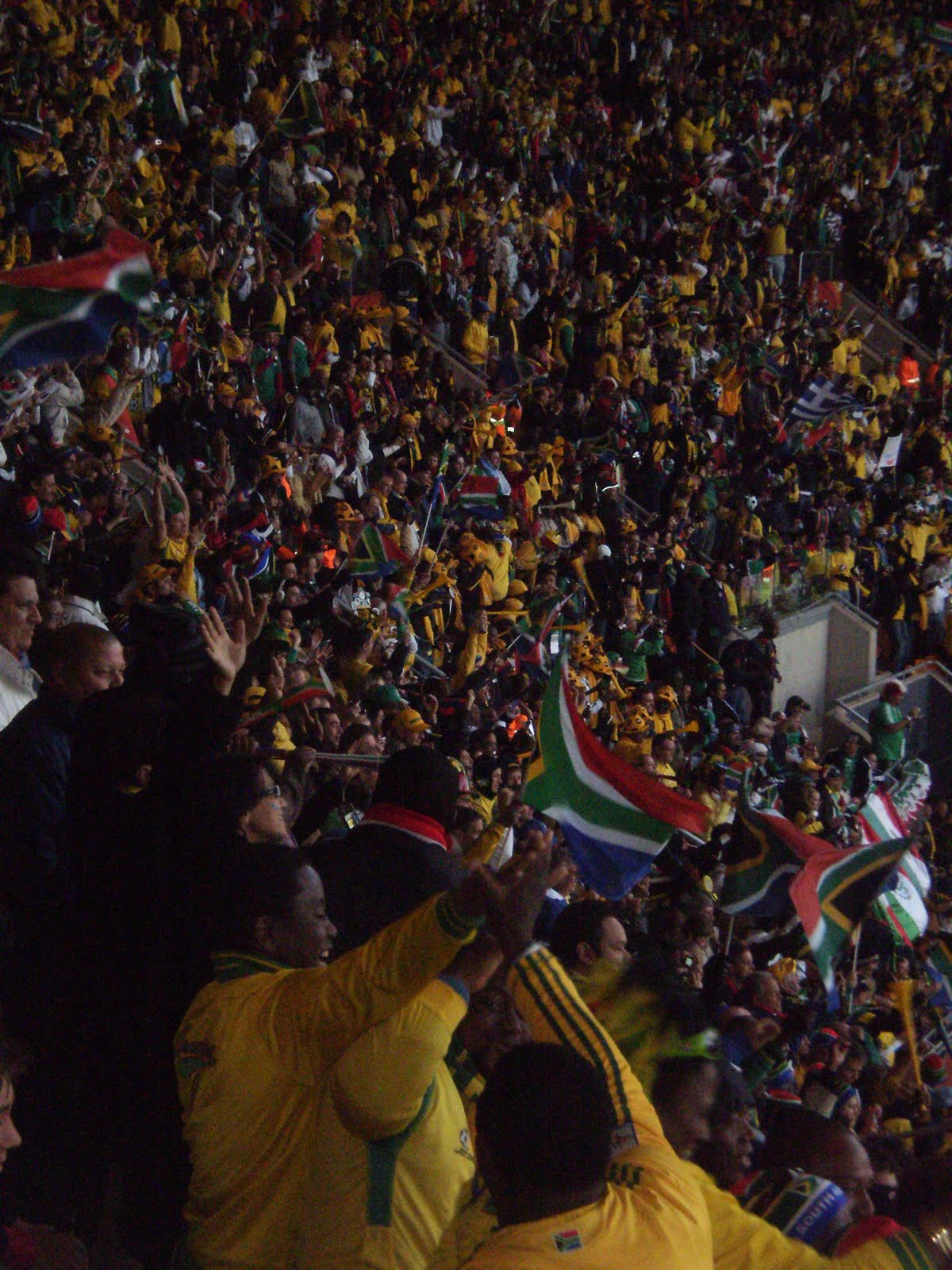
South Africa 1 Mexico 1
Well, that was a bit of a buzz. Which almost had a sting in the tail.
Even Sepp Blatter, football’s most powerful man, looked and sounded a little taken aback by the pure power and intensity of Africa’s long-awaited World Cup welcome, as he forgivably gifted himself a little pre-match speech on the pitch.
And just when the relentless intensity inside the Soccer City ‘cooking pot’ bowl had reached the very top of its range, somehow the crowd - that feverish swarm of vuvuzelas - could send the volume surging still higher to a Spinal Tap-style level eleven.
Siphiwe Tshabalala’s sweetly-lashed opener should guarantee the self-proclaimed YouTube addict a hefty segment of the site to himself.
He spoke before the match about spending hours following ‘best free-kick’ links, to hone his own set-piece technique, but today’s open-play piledriver could provide a few lessons of its own.
And not just in the finish – Fulham’s Kagisho Dikgacoi need feel no urge to change his name, after a clever and committed second-half display and the cute through-ball putting Tshabalala on a clear path into the history books.
Patches of empty seats suggested the announcement of a capacity 84,900 crowd might have been a little less accurate than Tshabalala’s aim.

Yet there could have been twice as many crammed inside here, judging by the racket this bouncing, beaming crowd created – expressing somehow both a nervous make-the-most-of-the-moment disbelief and a satisfied this-is-how-it-should-be self-assurance.
While there was little let-up in terms of sound from the fans, the home players’ own confidence came and went.
A rocky, sloppy start, as the Mexicans threatened to canter away with it, was followed by some modestly intricate passing moves as the first half scampered by – especially as Pienaar deserted his right-wing station as if worried he might miss out on some fun.
His team’s left flank certainly needed some bolstering, with Giovani dos Santos sparkling and yet often found himself usefully overlapped by his own right wing-back, Paul Aguilar.
Yet early indications that Aguilar and central midfield organiser Gerardo Torrado would run the match just the way they wanted gradually receded.
South Africa not only hung on until half-time – helped no little by goalkeeper Ike Khune and a dutifully-flagging linesman – but could have nodded themselves into the lead, had lumbering frontman Katlego Mphela.
Did Mexico really need to persevere with three men in central – if elastic – defence when faced by a harmless Mphela and, tucked just behind, a miscuing Teko Modise?
At least the belated arrival, in the second half, of Andres Guardado gave them both impetus and deadly crossing down the wing, even if by that point South Africa had taken the lead, missed a sitter (Modise) and been denied a perfectly-arguable penalty.
Rafael Marquez, curbing his instincts to roam like an old-fashioned centre-half for much of the game, did turn up in the right spot at the right time to swipe an equaliser.
South Africa had ten men in the box as Guardado’s crucial cross swept over, though captain Aaron Mokoena could feel aggrieved to find himself abandoned and left to cover up to four attacking Mexicans.
Inevitably, one of them ended up hitting the net, suggesting home coach Carlos Parreira – a zonal marking devotee – has at least a little more fine-tuning to do.
But the fans sounded a fairly forgiving bunch, the only moment of quickfire quiet coming in the few seconds after an anti-climactic – and inaudible – final whistle.
The pipes were soon parping again – surely lips should be chapped, lungs running out of puff? – as the makarapa-helmeted heads bobbed back down the stairs and ramps, out on to the streets, and into the night.

For the second World Cup in a row, an opening game has proved a refreshing and entertaining sight – though even that bubbly Allianz Arena crammed with even bubblier Bavarians never felt nor sounded quite like this.

"Tell me what you see..."

Just quickly, a few pre-tournament predictions:
Winners: Brazil – dull Dunga took great pride in their jogo bonito-lite triumph in 1994, and could repeat as coach what he achieved then as captain, with a robust and ruthlessly-efficient counter-attacking team. At least Kaka, Dani Alves and Maicon have class. The two old Gilbertos, both once of North London, look less understandable
Runners-up: Italy. Such a simple group means even they might struggle to make their archetypal slow start, so maybe they’ve just been getting it out of the way earlier in dispiriting pre-tournament friendlies. Not quite so ageing as expected (the sadly-going-going-long-gone Cannavaro aside), while the midfield has bite in De Rossi and craft in Montolivo. And they’ll be intent on resuming normal service against Spain.
Semi-finalists: Argentina, Ghana.
England’s prospects: Same old, same old quarter-final. Though, just to be original, having knocked out Germany in the second round.
Surprise packages: Well-organised but feisty Ghana, Marcelo Bielsa’s tactically-daring and flair-filled Chile.
Golden Boot winner: After the 2006 World Cup, for the first time, featured not a single hat-trick, how about Spain’s David Villa to hit two en route to the Golden Boot?
Non-superstar stars: Argentina’s Angel di Maria. Mexico’s Giovani dos Santos. Chile’s Matias Fernandez. New Zealand’s Chris James, also of Barnet. One of these, maybe not.
Miscellaneous: John Terry and/or Ashley Cole sent off. More English red cards, albeit a fair (or unfair) few flourished by Howard Webb. And unlike in 1966, North Korea to actually hold on for a draw against Portugal this time.

"We all face the same way..."

In the predictably-gridlocked streets approaching Soccer City, the resentful-elephant drone of the vuvuzelas has to harmonise – of sorts – with the pounding of stationary car horns.
It may be a bit of a din, but it’s a joyous one – even if it has just taken more than four hours to crawl the 30km from Pretoria.
Apparently even the South African team are struggling to get their bus out of the Johannesburg suburb of Sandton - setting for a similar snarl-up for that premature open-top bus tour on Wednesday, though they didn't then have a rather important match just a few hours later.
Organisers may have warned people to leave their cars at home, and many exuberant ‘Bafana Bafana’ are scampering by on foot.
Yet perhaps the very first World Cup finals match ever staged on African soil was always going to cause a bit of a jam, even with the dubious pomp of the opening ceremony to come first.
In such an ebullient atmosphere, it would certainly seem a little churlish to buy a pair of earplugs – cannily offered at 15 Rand apiece, or £1.50, by a lady darting her way through the traffic in a typically-vivid sandwich board.
Occasionally, over the amateur horn concertos that have been playing since dawn, there might come a human cry of ‘Shapa, Bafana, shapa!’ – that is, ‘Beat them, boys, beat them’.
The hosts look determined to make the very eye-catching, ear-splitting most of this historic event, so long in the waiting, so controversial in the making and so hopefully sweet in the staging.
The morning newspaper forecasts appear resigned to first-round heartbreak, though the fans themselves are not so sure – not a bit of it, in fact.
‘The World Cup trophy is ours. We’ve already won it. There’s no way it will leave the country,’ declares optimists’ optimist Tefo Khuse, while Oko Nkungwana insists: ‘I know the Bafana will beat the other teams.’
Not any more cocksure than you’ll no doubt find in England, of course, though it’s all easier said than done – especially with some tasty Mexicans up first this afternoon.
The Central Americans, coached once more by 2002 World Cup manager (and 1986 World Cup red card offender) Javier Aguirre, were niftily impressive at Wembley last month – even though dire defending at setpieces gifted England a stodgy win.
Stereotypically-speedy wingers such as Giovani Dos Santos, Andres Guardado and – flickeringly – Carlos Vela certainly drag defences wildly about and stretch the active playing field as wide open as, well, Group A itself.
But South African’s Brazilian World Cup-winning coach Carlos Parreira will have spent three months of intensive training not only improving fitness – as seen in the recent 12-match unbeaten run – but emphasing similar playing ideals.
Like the visitors, the hosts should be looking to hoard possession when possible and deliver the ball at speed – still patrolling and hustling in midfield, should the Mexicans prove slightly more successful at the art.
Parreira cites as one of his favourite footballing phrases: ‘A rapid pass with accuracy is one of the most devastating weapons.’
(You might say ‘If it were done when ‘tis done, then ‘twere well it were done quickly’, if your name were Macbeth – perhaps a certain South African midfielder, surname Sibaya, should try it.)
Okay, so South Africa will struggle to do so, quite as devastatingly nor enchantingly, as, say, Spain two years ago at Euro 2008 or in most of the months since.
But the home fervour, recent match-winning morale boosts, and a new-found physical robustness, could tilt this game if not decisively in South Africa’s favour, then at least a little against a massacre by Mexicans.
Perhaps it really will all come down to a struggle between the soundtracks – vuvuzela versus mariachis.
There’s only one way to settle this – pipe...

"Begin the begin..."

‘SOUTH Africa 2010 – it’s possible.’
The old slogan could have done with a little extra oomph, when planners made a courtesy call on Euro 2008 – perhaps cowed by the power of Euro-scepticism. Or, simply, cynicism.
Doom’n’gloomy headline revenge may well be wreaked on Olympic London in two years’ time.
But for now, those behind Africa’s first World Cup could be forgiven for feeling a little battered by scare stories, from reasonable alarms about crime and travel safety to fatuous warnings about Egyptian cobras that could each devour two 23-man squads.
Instead, as organisers and volunteers launch one final heave, they look exhilarated – not because the effort’s almost over, but vindication could be theirs.
To risk stating the bleedin’ obvious, Sepp Blatter’s Fifa cannot always be relied upon to get things right.
Putting electronic voting pads to the test at Fifa Congress yesterday, seven blazers still somehow answered ‘No’ to the simple sample question: ‘Are Italy the reigning world champions?’
But giving South Africa a World Cup of its own – even at the second time of asking – was a leap of faith that could prove its own reward.
Many toiling in squalid slums or refugee camps might well wonder still what they get from a tournament costing £4billion while pumping hefty profits into Fifa coffers.
True, the World Cup spotlight has helped stimulate some healthcare and education aid, from Fifa’s ‘Football For Hope’ scheme to many smaller-scale, grass-roots initiatives.
Yet today might provide a more persuasive answer – albeit one richer in emotion than redistributive hard cash.
Nelson Mandela and fellow Robben Island prisoners used to bolster morale with competitive kickabouts, or tuning into scratchy snatches of World Cup radio commentary.
Now football, always favoured by the black majority, can invade and upgrade venues once the preserve of the rugby-loving Afrikaaner minority – with access to soccer stadia happily traded in return.
Today’s message is ‘Africa United’, convincing even if prominent poster boys Michael Essien and Jon Obi Mikel have become injured absent friends.
A traditional sangoma forecasts a valiant South African defeat in the final, having ‘thrown and read the bones’ – a grislier twist on the remains of the Earl Grey.
Speak to many ‘Bafana Bafana’ fans and they’ll suggest no such thing – seeing a semi-final place as rather more realistic. For now.
Yes, it’s that clichéd – yet irresistible – ‘feelgood factor’, sweeping a country, a continent – and from a few hours’ time, a whole small world too.
And well, if the South Africans can’t blow their own trumpet…
Speaking of which, Wednesday was official National Vuvuzela Day, with the instruction to honk hard on those horns for 15 minutes solid at midday.
(Don’t worry – there are only another 31 unofficial national vuvuzela days ahead.)
And when it all comes to an end on July 11, so what if these stunningly unique – and expensive – stadia, their vivid paint still damp, get used for nothing so significant ever again?
Because, ah, look at what they’re being used for now.
That is, showcasing the Rooneys, Messis, Pienaars and surprise heroes still to stake a claim – enthralling
3million fanatics in the stands and 3billion pairs of eyes goggling at the box.
South Africa 2010 – it’s here. Anything’s possible.

"Waiting for the wait to stop..."

TODAY’S dawning of Africa’s inaugural World Cup ranks in history alongside Nelson Mandela’s release and South Africa’s first free elections, the man in charge has declared.
World Cup boss Danny Jordaan also gave the strongest signal yet that 91-year-old former president ‘Madiba’ will be well enough to appear at today’s long-awaited grand opening – though he spoke before the tragic death of Mr Mandela’s great-granddaughter.
Dr Jordaan, who has strived for 16 years to bring football’s showpiece event to Africa, promised this would be the finest World Cup in history.
And he revealed how South Africa was fired up by international scepticism about the their abilities to stage the event – especially cynical taunts from England.
Former sports minister Tony Banks once told him anyone rating South Africa a better World Cup host than England ‘must believe Elvis is still alive and living on the moon’.
A 1,500-strong cast will perform in a two-hour opening ceremony at Johannesburg’s revamped Soccer City stadium this lunchtime, before the hosts kick off against Mexico.
Dr Jordaan, a veteran anti-apartheid campaigner and former MP, yesterday repeatedly ranked the World Cup ‘struggle’ alongside those for freedom and equality.
He expects June 11 2010 to go down in history alongside February 11 1990, when Mr Mandela walked free, and the first post-apartheid elections on April 27 1994.
Dr Jordaan said: ‘Madiba’s release was celebrated as one of the world’s greatest icons.
‘The election was dubbed a miracle of the “Rainbow Nation”.
‘Now this will be another spectacular moment.’
On whether Mr Mandela would make it to Soccer City today, he conceded: ‘It’s a very difficult question.
‘Nelson Mandela himself wants to be there.
‘Whether he stays five minutes or the whole match is not our decision, but as things stand there’s a very very great chance he will be there.
‘We’ll just be happy if he shows his face.’
But that was before the ex-president’s 13-year-old great-granddaughter Zenani Mandela was killed in a car accident in central Johannesburg last night.
The organising committee today expressed their sadness and paid tribute to Zenani, who brought the Confederations Cup trophy on to the Ellis Park podium for the final of last year’s tournament.
Just a few hours earlier before Zenani was killed, three British students died when their tour bus overturned near Nelspruit
The 20-strong party from Leicestershire were not in South Africa for the football, but the accident suggested to some that the country’s roads were still unfit – despite receiving up to £310million of government funds.
The last few days before kick-off had already been marred by a stadium stampede during an international friendly on Sunday and the gunpoint robbery of three foreign journalists on Wednesday.
And preparations have long been dogged by concerns about crime and security, beleaguered healthcare, and whether the ten matchday stadia would be ready in time.
Yet on the football side, total infrastructure investment worth £4billion has helped ensure all ten venues were ready - and among the most distinctive in World Cup history.
Other work delivered on time include widened highways, a new airport at Durban and another air terminal at Johannesburg – while organisers claim to have created 150,000 new jobs.
Cape Town will host a three-day economic summit mid-way through the tournament, hoping to capitalise on the World Cup’s success and attract international investors.
Dr Jordaan vowed visitors and viewers would be wowed by the stadia and other infrastructure and ‘begin to understand what we talked about wasn’t just talk’.
‘It’s a determination to present the best World Cup ever,’ he added.
‘It’s a psychological barrier that’s been crossed – it’s a historical moment that’s being changed.
‘We’ve always said the World Cup must be a celebration.
‘It must help an image makeover, in the country and the continent.’
He admitted feeling frustrated by negative headlines and speculation, but said: ‘You have to be calm and not lose sight of the ultimate aim – that everything will be fine and this World Cup will be great.’
Kirsten Nematandani, president of the South African Football Association, added: ‘Today it feels good to be an African.
‘Today I woke up in a country ablaze with the bright colours of a very special flag.
‘From taxi drivers to gleaming new sports cars, everywhere is alive with the colours of the “Rainbow Nation”, on the brink of a very special celebration.’

Thursday, June 10, 2010

Know which side your bread's Blattered...

"I'm a happy man, I have a happy Congress", declared generous Sepp Blatter 12 months ahead of his FIFA presidential re-election attempt...
... and moments after an announcement of £134million in profits and £723m in assets helped him produce surprise £170,000 bonuses for each member FA, and £10millions apiece for the confederations such as Uefa.
Never mind hat-tricks - is it trebles all-round?

"If you didn't come to party, then why did you come here?"


THOUSANDS of fans streamed the streets, cheering on the football heroes basking in glory on an open-top bus.
Hang on – isn’t this how World Cups are supposed to finish, not begin?
Then again, when your team fears becoming the first host nation to fall at the first hurdle, it might be best to celebrate when you still can.
Roads jammed, offices emptied and those pesky vuvuzela horns honked hard as the South Africa squad took a not-quite-earned-yet lap of honour around the Johannesburg suburb of Sandton.
The South Africans could yet surprise, of course – suddenly looking like they might just be the best-performing African team after all.
They go into tomorrow’s big kick-off on the back of a 12-match unbeaten run, under the leadership of Brazilian World Cup-winner Carlos Parreira.
And their continental rivals have been hit by injuries to Jon Obi Mikel’s ankle, Michael Essien’s knee, Didier Drogba’s elbow and Samuel Eto’o’s ego.
The hosts have at least shown already they can party hard – and fast. Win or – yes, much more probably – lose, yesterday’s gala won’t be the last.

"Keep on knockin' but you can't come in..."

THE TEN host venues have all finally been topped out and now look in tip-top condition.
World governing body Fifa at last felt confident enough yesterday to announce precisely how many seats would be available in each one.
Yet more than 40,000 could be going to waste, so to speak.
The ten stadia offer a total of 514,599 seats, ranging from the 84,490-capacity Soccer City in Johannesburg to the 38,646-seat Royal Bafokeng in Rustenburg.
Tot up the venues’ gross capacities when not taken over for World Cup purposes, however, and you could squeeze as many as 556,000 bums on to seats.
Blame those usual suspects – VIPs and their hospitality suites. And, admittedly, the media – though mainly those wielding cameras.
The last 35,000 tickets are now up for grabs, being peddled yesterday at about £140 apiece for best seats – or for one-tenth as much, close to the touchline but with restricted views.
Sat behind Peter Crouch on the subs’ bench perhaps, – or the smoke from one of Diego Maradona’s fat cigars. Or just Maradona’s own fat.

Home, home on the range...


FABIO Capello has been giving football tips to his US counterpart – though it took a while for Michael Bradley to even realise.
Praising Capello yesterday for his tactical flexibility, the US coach said: ‘The quote’s he always used with me was, “When you make wine, the grapes aren’t always the same.”
‘The first few times he said it, I thought he was actually talking about wine.
‘I only eventually realised he was trying to tell me a few things about football.’
Bradley could in fact turn his hand to milk-churning instead of grape-crushing, as the good ol’ boys of the USA spend this summer down on the range.
The squad is based around the Irene dairy farm, near Pretoria, where players can find themselves picking a path through cows and chickens en route to public appearances.

"But I want to know for sure...?"

ENGLAND’S figure-conscious Wags have been promised a slap-up meal by their highest-profile South African equivalent.
Matthew Booth’s wife Sonia wants to take the likes of Victoria Beckham, Coleen Rooney and Christine Bleakley to her mum’s home in Soweto and force-feed them an authentic local feast.
‘Pap, boerewors, chakalaka – nothing fancy, just traditional South African food,’ she promised.
(Pap is a kind of porridge, boerewors a sausage and chakalaka a spicy relish.)
And if Posh finds such pap hard to swallow, she should try forcing down the ‘Wild Thing’ offered to many visitors almost as soon as they arrive.
This Wild Thing that might indeed make your heart sing – though with pain, not pleasure – comprises hefty chunks of springbok, ostrich and warthog on a spit.
Your non-daredevil, meat-dodging Metro reporter made his excuses … and ordered the salad.

"I'm so bored with the USA..."

AMERICA’S tough tacklers have warned England to expect a ‘good hard game’ – but insisted they will not try to deliberately wind up Wayne Rooney.
US coach Bob Bradley promised a robust approach in what American soccer chiefs yesterday described as the most exciting football match in the country’s history.
But he also expressed respect for temperamental Rooney – as well as England coach Fabio Capello, who once faced a US college team coached by Bradley.
The man now leading the USA’s sixth consecutive World Cup finals campaign once took a Princeton University team to AC Milan’s Milanello base, in the mid-Nineties.
They took on a team of Milan reserves, in a coaching session overseen by the Serie A giants’ then-boss Capello.
Bradley expects Saturday’s match to be a little less friendly, but vowed no dirty tricks – despite renewed questions about Rooney’s volatile temper.
When asked whether his players would deliberately target Rooney, he said: ‘No, we won’t enter all that.’
Bradley spoke of ‘a tremendous respect for Rooney as a player’, praising ‘his effort, his competitiveness, his movement’.
USA captain Landon Donovan predicted: ‘I think Rooney’ll going to be just fine on Saturday.’
But Bradley pledged: ‘It’ll be a good, hard game.’
Brazilian referee Carlos Simon has been accused of card-happiness, while also serving a brief domestic suspension following complaints about his officiating.
Bradley will advise his men to be careful, saying: ‘It’s important that there’s discipline.
‘We’ve seen in a number of World Cups, especially in the first round, that players must respect their opponents or else there’ll be cards given.’
The US have won a reputation for being among the most athletic, and physically robust of international sides.
Even US Soccer chief executive Sunil Gulati yesterday admitted American players tended to lack flair.
Bradley was assistant coach when the US were involved in one of the last World Cup’s most X-rated matches, reduced to nine men in a group game against Italy.
Pablo Mastroeni and Eddie Pope were both dismissed in Kaiserslautern for wince-inducing challenges.
The violence was not all one-way – striker Brian McBride took an elbow-smash to the face from Daniele De Rossi, who was also sent off.
But while neither Mastroeni nor Pope are here this time, cards can be expected by the likes of the coach’s own son Michael Bradley.
The combative Borussia Monchengladbach midfielder’s tendency to collect bookings saw him suspended from the final of both the 2009 Confederations Cup and the same year’s CONCACAF Gold Cup.
Premier League fans may still vividly recall US striker Jozy Altidore’s headbutt assault on Sunderland’s Alan Hutton, when playing for Hull City last season.
Donovan himself was involved in the incident which left Chelsea and England left-back Ashley Cole’s World Cup place in doubt last season.
While yesterday insisting he was glad to see Cole recovered in time from his ankle injury, Donovan said there had been no contact between the two players – nor with his LA Galaxy team-mate David Beckham.
But Donovan, who spent the second half of the season on loan at Everton, said he expected the club’s Scottish manager David Moyes to be cheering on the US.
The forward, who said any talk of an Everton return would be delayed until after the World Cup, said: ‘I’ve had no message from David Moyes.
‘But my guess is, learning a little bit about how the English and the Scots are, is that he’s rooting for us.’
While the England camp remains plagued by injury doubts, Bradley declared: ‘Every player in my 23 is ready to play 90 minutes if asked.’
That includes, he insisted, the ex-Newcastle Uniited centre-back Oguchi Onyewu, who missed most of his first season at AC Milan with knee ligament damage.
Saturday’s clash with England is the talk of the watercooler across the US, according to football federation chief Dr Gulati.
He added: ‘There’s more interest back home in this game than any the US has played for a long time – probably ever.
‘The national team has even featured on the front cover of Time magazine – anyone remember when that’s ever happened for soccer?
‘Certainly the watercooler talk is greater for this Saturday than I’ve ever seen for a World Cup.’

More of my back pages...

Because, well well, just because...:
http://metro.typepad.com/euro_2008_blog/
Now, what's next? Ah yes... that's enough playing (pointless) catch-up.

Zimbabwe in December 2008...

Whatever Robert Mugabe may want the world to believe, cholera continues to plague Zimbabwe and especially wretched border town Beitbridge.
The United Nations this week said the cholera death toll in Zimbabwe had risen from 792 to 978 - though many suspect the true total could be more than 2,000.
An undercover Metro visit to the chaotic country found harrowing conditions and aid shortages, even as Mugabe was robustly insisting the illness had been cured.
Anyone passing through southern Africa’s busiest border post, at Beitbridge, may find coffins leaking infection, and a mortuary crammed with unclaimed corpses.
Carefree children splash through open, broke sewers, while homes have gone without tapwater for almost a month - prompting thirsty families to down handfuls from poisonous rain-filled ponds.
Dying bodies have been scattered outside over-stuffed hospital wards, attached to IV drips hanging from the branches of trees.
Struggling and sleepless medics in Beitbridge told Metro the disease is now thought likely to spread even more damagingly beyond the current hotspots, especially into under-resourced rural areas.
Some also fear the spillover into neighbouring South Africa - with more than 600 cases reported already - could lead to the border being closed.
This would be disastrous for Zimbabwe, which now relies on imports from South Africa - and to a lesser extent Botswana - for almost all its food, fuel and medical supplies.
For the moment, South African trucks continue to bring the meagre supplies of treated water, antibiotics and purification chemicals so anxiously needed in Beitbridge.
A senior hospital official admitted: ‘We barely even had a button to sell - we had nothing.
‘Without outside aid, this disaster could have been so much worse.’
Despite foreign journalists being banned from Zimbabwe, Metro gained access to Beitbridge’s hospital, where a depleted staff has been working virtually non-stop for the past month.
The ramshackle wards may be protected by handwashers and decontamination sprays at every entrance and exit.
But the rusty metal hangers from which drips connect to twisted and helpless patients, lying malnourished on hard-backed beds, hardly inspire confidence.
Nor does the makeshift treatment camp just outside the hospital walls, where mothers and babies slump under 30-degree sunshine, reluctant to force down their medicine.
Similar scenes can be found in outlying villages such as Lumamba and Chamungangana, though the hospital’s grimy stone walls are replaced by canvas tents propped up by wooden poles.
These places feel eerily quiet and deserted, with few signs of life outside the field hospital tents or cramped clinics.
Incomprehending and glazed eyes stare up from each bed, young children, young men and women laid low by an illness that can kill within just a few hours of the first symptoms showing.
Pastor Moffat Ndhlovu, of Beitbridge’s World Pentecostal Evangelical Church, recalls with horror the hospital struggling to cope with the first outbreak last month.
He said: ‘When I walked into that place - well, I’ve never seen such humiliation in my life.
‘You’d find one woman lying here naked, and a man naked lying next to her. One would be vomiting, flowing into the next.
‘Others patients’ diarrhoea was flowing into the people next to them. There were so many lying so close because there weren’t enough beds, not even enough space.
‘Doctors ended up taking some of the victims outside - hanging drips from the branches of trees.
‘It got so berserk, they had to close the hospital to anyone who didn’t have cholera.’
‘Oh, it’s been a tough time,’ sighed an assistant at Beitbridge’s hospital morgue, while swinging open three fridge doors to reveal 18 corpses.
Some had lain there unclaimed for at least three weeks, their addresses and families unknown - and local government unwilling or unable to fund any inquiries.
When admissions were highest at the end of last month, the morgue was taking up to 20 new bodies every day.
About ten corpses have been discovered and brought in from dense and desolate bushland outside the town.
Mr Ndhlovu said: ‘Before cholera, I’d go for months without having to conduct a funeral - now it’s five or six a week.
‘There are so many now, every pastor here’s been so busy.’
Some funerals have only added to the danger, with a shortage of body-bags allowing infection to escape at the open-coffin funerals popular with some communities here.
The busy bus terminqals, serving key routes out of town, may also have helped spread infection - as might the thriving sex trade on Beitbridge’s outskirts.
But as Mr Ndhlovu emphasised: ‘The conditions for cholera are endemic in Beitbridge - the lay-out is badly planned, the weather is so humid, it’s dusty and it’s dirty.’
His home in Beitbridge, like many others, has been denied running water for the past month.
While Metro were visting, there were cries of delight when the kitchen taps suddenly began flowing again.
But the smiles quickly turned to frowns of disgust as bottles filled with a brownish gloop - fit only for use in toilets.
‘And this is supposed to be treated water,’ a neighbour remarked. ‘I wouldn’t have liked to see what it looked like beforehand.’
Little wonder the hospital official declares: ‘I can go to any cholera outbreak in the world after this, knowing I can’t see anything worse.’
And little wonder Mr Ndhlovu concedes: ‘We don’t presume the crisis is over. The worst could be still to come.
‘The truth is, the health system in Zimbabwe has completely collapsed.’


*** Human rights activists are being spied upon and even abducted, while elderly grandfathers beaten up and threatened with a bullet live in fear of their lives. 
If some had hoped Robert Mugabe was slightly mellowing, during truce talks with oppostion leaders, recent events suggest the Zimbabwe president remains as ruthless as ever.
Much of the country’s infrastructure and public services may be in meltdown.
But Mugabe can still call upon a loyal cadre of well-paid acolytes - eager to keep enforcing a ferocious crackdown on dissent.
Campaigner Jestina Mukoko is the most high-profile of almost two dozen government critics recently abducted by Mugabe’s men.
And while the president was publicly mourning government colleague Elliot Manyika, few ordinary Zimbabweans believe the official explanation of the national political commissar’s death.
Manyika had appeared to be at the centre of bitter Zanu-PF infighting, just weeks before his death in a car accident on Saturday last week.
Many people were surprised to hear that in a country with so few working medics, a government doctor was passing just ten minutes later to take care of Manyika’s body.
Conflicting times of death were later given by state authorities, while the government Mercedes in which he was being driven appears to have gone missing.
Of course, any suspicions have not been aired on tightly-controlled state media - only on South African TV channels, broadcast through the satellite dishes Mugabe wants to ban.
One in five Zimbabweans are believed to be paid informers for the ruling Zanu-PF party - including many posing as activist church pastors.
Police officers are mounting more and more roadblocks, some to enforce state control and some to replace missing wages with braz enly-sought bribes.
Even elderly grandfathers are not immune from being brutally beaten and intimidated by Zanu-PF thugs.
Bernard Haruvishe was abducted from his home, repeatedly punched, and dumped half a kilometre from his home - with a bullet left ominously in his hand.
The 66-year-old’s crime was to stand as a Movement for Democratic Change candidate, in local elections in Maswingo - and beat his Zanu-PF rival.
When his dead-of-night attackers - eleven rifle-wielding soldiers - handed over the bullet, they promised to return some day to finish him off.
But Mr Haruvishe has continued to stand up to his oppressors - collecting not only the names of others attacked, but also those suspected of carrying out the violence.
His lists also catalogue crops destroyed, as well as property, maize and livestock stolen.
The former teacher said: ‘Of course I was scared. But I refused to give the soldiers the names they wanted.
‘I just told them I’m an elected councillor - I won my election. I didn’t force people to vote for me.
‘Not only my grandchildren, but everyone of school age in Zimbabwe - they’re being lost. I can’t see how they’ll ever recover from what Mugabe is doing to this country.
‘I don’t know when Mugabe will go. But I wish it could be today.’
Neighbour Andrew Maziye Sithole, 70, has been beaten up twice, with sticks made of cane and matted with thorns.
But he refuses to quit as an MDC official or to stop speaking out against the Mugabe regime’s human rights abuses.
Mr Sithole, who has scars and welts across his neck, back and arms, said: ‘We sleep in fear of being “disappeared”, captured and killed by the Mugabe people.
‘This area has become very dangerous - even the local tribal chief has been giving commands to beat and kill any critics.
‘But even as they were beating me, I told them I wouldn’t resign as an MDC official. I saved my true heart.’
The father-of-18 and grandfather-of-eight added: ‘Zimbabwe is a country with a heart of gold - but the teeth of Mugabe.
‘He’s killing innocent people. Every day they’re dying. Only when he leaves will we see the sun rise.’
But father-of-two Mike Tizirai, 30, fears there will be ‘fighting and burnings’ over Christmas, as people rebel against the bleak midwinter conditions.
He spent three months hiding in mountains immediately after the June election, leaving his children with his Zanu-supporting parents-in-law.
‘They saved my children’s lives,’ he concedes. ‘We just don’t discuss politics.’
Zimbabwe Christian Alliance pastor Wilson Mugabe - no relation, as he has to keep insisting - takes pride in pointing out Zanu-PF plants in church meetings.
He h as been arrested several times for inciting opposition to the government, in his sermons and speeches.
Activist church pastors like himself have often had their phones tapped, prayer sessions infiltrated - and described in detail in anonymous calls - and families threatened.
But Wilson keeps on campaigning, saying: ‘I only become bolder. I want to argue with these people, expose them in meetings.’
Once he was dumped, wearing only shorts and a blindfold, high in the mountains above Masvingo - forced to wander 10km for help and direction.
His uncle Bruno Mugabe was a Zanu-PF supporter - but even he fell foul of the party, when attempting to stand against a favoured candidate.
Bruno was killed by a hired mercenary, injected with poison while driving and dying when the car careered off the road.
Wilson turned down the chance to become an MDC candidate in Masvingo this year - but is considering standing if fresh elections are forced next year.


*** Gordon Brown has been told to keep quiet about Robert Mugabe – by one of the Zimbabwe dictator’s most outspoken critics.
Condemning Mugabe from outside Zimbabwe is counter-productive and only falls into the tyrant’s trap, Wellington Chibhebhe told Metro.
Instead, he demanded, Britain and the US should be putting pressure on those countries allowing Mugabe to stay in power – such as South Africa and China.
Mr Chibhebhe has himself paid a heavy price for opposing Mugabe – at least 20 arrests, and beatings which have left him with a fractured skull, disfigured fingers, a metal plate in his arm.
He is secretary-general of the Zimbabwean Congress of Trade Unions, the successor to Morgan Tsvangirai – who now leads opposition party Movement for Democratic Change.
Despite his organisation’s close ties to the MDC, Mr Chibhebhe accuses some party insiders of losing touch with their grass-roots support – and feels ‘no hope’ that Mugabe can be ousted any time soon.
But he believes attacks on Mugabe by British ministers only gives the president what he wants – allowing him to ‘play the race card’, while indulging in ‘eloquence and acrobatics’.
Mr Brown and foreign secretary David Miliband have both recently called for Mugabe to go.
The Zimbabwean president retaliated last week by accusing Britain of planning to invade – while his Zanu-PF party colleagues have even blamed the UK for the cholera plaguing the country.
Mr Chibhebhe insists Mugabe does not hate, and instead ‘loves’ Britain – especially the Queen and Harrods – but feels shunned by Zimbabwe’s former imperial ruler.
Mr Chibhebhe said: ‘Whoever’s seen to be anti the regime here now is automatically labeled “British”.
‘But this all comes not from Mugabe’s hatred for the British, but his love for the British – he just feels neglected by the country.
‘He’s described himself as the biggest admirer of the queen, and Harrods records show he was one of their best customers.
‘Even if he was traveling to somewhere like China, he’d go through London to do his shopping.
‘Gordon Brown is now making political statements condemning Mugabe, but they may actually be arming him instead.
‘He’s able to use these statements to rally his colleagues around him – suggesting this is Africa being attacked by whites.
‘These attacks just bring the best out of Mugabe, in all his eloquence and verbal acrobatics, and his view will resonate with most African leaders because they’re dictators too, and see him as their leader.
‘The world, including Britain, needs to use other forms of pressure instead.’
He wants similar moves to those which helped topple Ian Smith, Rhodesia’s last white prime minister before Mugabe took power in 1980 and changed the country’s name to Zimbabwe.
Mr Chibhebhe said: ‘South Africa must be pressured – and the world must allow start thinking about how to deal with the likes of China, who have business links in Zimbabwe and always veto sanctions.
‘Pressure was brought to bear on South Africa when they were doing business with Ian Smith – when they stopped, his world started collapsing around him .
‘Now Namibia is one of Mugabe’s lifelines, but the UK doesn’t seem to be doing anything to end its own trade links with Namibia.’
But he is pleased to see British ministers do all they can to avoid one-on-one meetings with Mugabe – even if Jack Straw was manouevred into an unwelcome handshake four years ago.
Unrelated Wilson Mugabe, a vocal Christian activist and opponent of the regime, clapped and cheered when he heard the president was talking of a British invasion.
He was only disappointed when told the claims were probably untrue, insisting a British military offensive would be welcomed by most Zimbabweans.
Mr Chibhebhe is not so hawkish, knowing how intransigent Mugabe and his allies can be – knowing from his own experience that ‘it’s harder to fight an ex-guerilla government than a normal one’.
His personal struggles have borne this out, with about 20 arrests – the most recent on December 3, when detained for protesting against limits on cash withdrawals.
His worst beating came two years ago, leaving him unconscious for two days while held in the notorious Matapi prison in Harare – in filthy cells condemned by the country’s supreme court.
‘I only came to my senses when lawyers were finally allowed to visit and bring some initial medication after two days,’ he recalled.
‘You get used to living in very, very difficult conditions, surrounded by human waste.’
But he insists he will not abandon his risky role opposing the government – fuelled partly by a sense of guilt at his youthful involvement in Mugabe’s 1980 breakthrough.
‘Giving up has never crossed my mind – not at all,’ he claimed.
‘If anything, I’m more persuaded to continue.
‘I was born and bred in the rural areas, participating in the liberation struggle. We were the youngsters responsible for the logistics.
‘Prior to independence, our fathers and mothers – who had relatively nothing in resources – they gave their all as a contribution to the struggle.
‘When I go back and see how they’re suffering and being so abused now, it greatly pains me.
‘And it keeps me going, hoping that one day our people will finally be free – and able to say: “Yes, what we’re fighting for has finally been achieved.”
‘We wanted to bring about independence, democracy and the accompanying freedoms for people.
‘Yes, we’re now independent, but people are not free and therefore there’s no democracy.’
He believes Zimbabwe’s ruined economy could be turned around by redistributing money from the military and security services to health and education instead.
‘More often than not, the military has got the biggest chunk of the budget, even though we’re not at war,’ Mr Chibhebhe said.
But first Zimbabwe needs to resolve the issue of ‘governance’ – putting in place a credible process for free and fair elections, monitored by the international community.
‘The current power-sharing negotiations are dealing with issues of power – who gets what jobs – rather than issues of democracy and people’s freedoms,’ he said.
‘When you look at the political game being played, we’re falling into the same old trap.’
He attacked MDC insiders who were spreading doubts at Mr Tsvangirai’s leadership, especially the taunts that he spends too much time outside Zimbabwe.
Mr Chibhebhe said: ‘Morgan Tsvangirai’s doing the right thing, because we need the global support.
‘We’ve heard the insinuations that he’s not the best leader for the process, but when you look around for leadership when it matters most, quite a good number are nowhere to be found.’
He admits he has ‘no hope’ of Mugabe being overthrown in 2009, however, even if cholera has proved an ‘unexpected disaster’ for the government to deal with.
But he added: ‘We are excited – though suspicious – that for the first time, Mugabe has been quoted publicly as saying his people should be preparing for elections within one and a half to two years.
‘He now knows this situation will never come to an end until or unless there’s an election.
‘On the other hand, we’re fearful he could go the other way – say “To hell with any deal”, or go all out on an even more terrible offensive – more abductions and torture, with the aim of totally disintegrating the MDC.’

*** Robert Mugabe’s critics are praying for Zimbabwe’s banks to finally, completely crash – and that day may not be far off. 
Mugabe’s government may still be trying to apply emergency fixes to the country’s crazy economy – such as the introduction of new notes and cash withdrawal limits.
But even the invention of a finely-crafted $500million note – made from material worth an extravagant eight US dollars – looks like doing little.
After all, that will shortly be the price for just one loaf of bread – if you can find any left on the stripped-bare shop shelves, that is.
At the start of last week, when Metro first arrived in Zimbabwe, a loaf cost $10million, hitting $20million the next and $100million last weekend.
Annual inflation now runs at an estimated 231million per cent.
And the amount of Zimbabwean dollars in the money supply has rocketed from $45billion two years ago to more than $900quadrillion today.
No wonder ordinary Zimbabweans, paid in local dollars, are desperate to get their hands on more valuable foreign currency, or ‘forex’ – primarily American dollars or South African rand.
Until last September, these foreign currencies were formally banned, but are now accepted by virtually all traders – though many workers now find themselves paid in kind instead.
Yet dealing in forex outside the banks remains illegal.
Hordes of currency-dealers – many of them young women, some with babies strapped round their backs – still congregate in central Bulawayo, anxious for business, though.
Some try to disguise their true purpose by flourishing lottery tickets or mobile phone ‘Airtime’ vouchers – though others shamelessly count, indeed flaunt, their wads of cash.
Not surprisingly, scams are common – often dealers will use the old trick of stuffing fake cash inside a couple of genuine notes at either end of a pile.
Long queues outside every bank begin forming the afternoon before 8am opening.
The banks only stay open until 11.30am, and often even those who have been waiting for hours will not be able to reach the front door until closing-time has passed – or all that day’s money has run out.
Fractious scenes could be seen at several branches, with bank officials either absent or reluctant to risk their own safety by stepping in.
Outside a branch of Barclays, customers were trying to allocate numbers to those waiting, so they could return home overnight and resume their rightful place the next morning.
But these arrangements seemed doomed to fail, especially with early-morning intruders commonplace – again, bank officials will usually find something else to occupy themselves instead of interfering.
Few people can remember just how many zeroes have been lopped off the Zimbabwean dollar – is it six, nine, ten, 13?
In fact, 13 have gone since 2006 – with rule-changes almost as frequent as the exchange rate changes that must keep all Zimbabweans’ calculating minds constantly whirring over.
Last Friday’s queues were waiting for their first chance to get their hands on new $200million and $500million notes – and to access a new weekly withdrawal limit worth $500million, rather than $100million.
That is, about $12.50 in US money – unheard-of amounts of money for many, in a country where the average wage across the countryside amounts to about one US dollar per week.
Those new $500million dollar notes are made from an unusual cotton material, supposedly to encourage consumers and traders to value the money more.
But with prices continuing to soar – and the country dependent for food and fuel on neighbouring South Africa and Botswana – that feels like little more than a futile hope.
Starving 72-year-old Emily Nkomo scrimped together a handful of cash for a 20km walk to her nearest miller’s store in the town of Nkayi – only to be told, on arrival, the notes were all worthless.
Even more worthless than most Zimbabwean dollars, that is – for these carried dates, showing they expired last June.
Mrs Nkomo, raising five orphaned grandchildren, had to beg among neighbours for a measly bag containing a couple of scoops of barley grain – enough to just about survive on for two days at most.
Part of that miller’s warehouse is shared by church project ZOE, but their section devoted to food aid supplies now stands empty – a victim of raising prices and falling availability.
Shops stand virtually empty by 9am – except for some products such as bottles of red and white wine, with Zimbabweans unab le to even afford drowning their sorrows.
Yet some instinct towards basic survival survives, both among individuals and the country itself.
Gold and chrome mines near the – relatively - affluent city of Gweru remain in action, close to the former ranch of white prime minister Ian Smith – the man overthrown by Mugabe in 1980.
Agape Missions church pastor Lyton Moyo admitted: ‘At times, you do wonder how people make it. What they earn, and the cost of living, just don’t tally.’
Some have family or friends sending packages from South Africa or Botswana – hence the fears about that would happen if the cholera outbreak in Beitbridge leads to the nearby South African border being closed.
Others survive on church hand-outs, though these are diminishing by the day – or the work of aid agencies such as Tearfund, or the World Food Programme which estimates 5million people are in need.
An estimated 90 per cent of the population are now unemployed, especially noticeable in public services as schools and hospitals shut down for lack of staff.
Teachers who earned $40million a month are quitting in droves, some in favour of positions as maids – who earn slightly more. Enough to pay for a loaf of bread, anyway.
For now, at least – as hyper-inflation wrecks day-to-day financial planning, as well as efforts by aid organisations to help.
The Churches In Bulawayo charity was alarmed, when buying some helpful sewerage equipment, to see their quote rise from US$13 per unit, to US$65 – in just 24 hours.
They decided it would be cheaper to buy the same kit from Botswana instead, even factoring in transport costs and import duties.
Christmas promises to be miserable indeed – but Zimbabwe’s very bleakness encourages some to believe 2009 can only be better, if utter chaos finally tips Mugabe out of office.
One leading human rights activist told Metro: ‘I’m excited about the new year. I feel the change is about to come. We’ve just about reached rock bottom.
‘Look at it all - first the schools closed, and then the universities, and they won’t reopen.
‘Hospitals are now shutting down, one by one.
‘Police officers are only surviving on the bribes they take at roadblocks, which is why there are so many on the roads now - they’ll just ask straight out, “What have you got for me?”, without bothering to search your car.
‘In fact, the only thing now - I just pray for the banks' collapse.
For one day, the bankers to decide they’ll stay at home from now on. And then, when there’s no money at all, that really will be the end.’


*** Famine in Zimbabwe has become so severe, starving families have been feeding on the skin of a cow - slaughtered six years ago.
One man has died since starting to eat the hide, which had been used as a grime-ridden rug in a village near Bulawayo.
Children as young as two have also been eating the skin, in an area not only hit by starvation and cholera fears - but also a cattle anthrax outbreak.
They have also been eating potentially poisonous creeper plants, after failing to get hold of even the most basic supplies of grain.
During an undercover Metro visit to the chaotic country, sick villagers explained how hyper-inflation, drought and widespread food and seed shortages were forcing them into dangerous and desperate measures.
Grandmother-of-seven Ellinah, 66, said: ‘Since the summer, we’ve had no harvest.
‘People used to help by giving us food, but everything’s dried up now.
‘We had nothing to do but eat the unthinkable.
‘Our ancestors used to keep the skin of their beasts, in case of drought or famine.
‘We just didn’t know what else we could eat anymore. Whatever we can get our hands on these days, that goes down.’
One of her sons, 43-year-old Dumisan, died a fortnight ago, leaving three children.
His relatives insist he was killed by hunger, rather than by eating the cow-skin - though admit all feeling unwell, including fortnight-long bouts of diarrhoea.
The hide has been sliced around the edges and boiled in salted water for the past three months, shared by families living in several neighbouring mudhuts.
Two separate shreds still remain - though church aid workers have been trying to persuade the villagers to give them up.
The creeper plants are more often used by poor Zimbabwean families in crushed form, as shampoo.
Church group Zimbabwe Orphans through Extended hands (ZOE) has a warehouse in the nearby town of Nkayi - but it now stands empty.
Tearfund-backed ZOE workers have seen a feeding programme for 35,000 families rise in costs from £1million this year to £2million next year.
They now struggle to get hold of food and fuel in a country which now depends largely for supplies on expensive imports from South Africa and Botswana.
The World Food Programme estimates 5million Zimbabweans are in danger of starvation, in a country where many families must survive on earnings worth one US dollar per week.

*** Hunger and deprivation may be sapping the strength, but not the spirit to go on, of starving families across Zimbabwe.
Some 35,000 families around Bulawayo look like missing out on much-needed supplies because Tearfund’s partner agency ZOE’s food aid programme has seen costs soar from £1million to £2million next year.
That kind of plight is replicated across the country, as hyper-inflation, corruption and harvest failures deny people access to help.
Gideon Chishamba’s church on the outskirts of Bulawayo cares for 69 children left orphaned by Aids, though he suspects many more are living in the area without support.
His church has had to cut, since September, their daily food hand-outs for the orphans – switching instead to weekly deliveries only.
Their partners in Harare were unable to afford – or get hold of – enough food anymore.
‘It was difficult to make that decision,’ Mr Chishamba said, with some under-statement.
The youngest orphan they support is a two-and-a-half-year-old boy, whose mother died eight months after giving birth and who is now brought up by his grandmother.
If grandparents are being forced to stay somehow younger than their years, by quasi-parental duties, then youths are having to mature unusually early.
Benevolence Mlotshua patiently, impassively scrubs his family’s rags in a foaming pail when visitors arrive at the isolated shack they tend in the village of Gumtree, near Bulawayo.
His seven-year-old sister Sinikiwe is even gloomier, barely raising even the glimmer of a smile, any signs of live-spirit at all, while trying her best to keep covered a protruding bellybutton that alarmingly resembles an old man’s hernia.
Benevolence, 19, comes across as authentically distraught – and disappointed in himself, somehow – to have left school at 13, following his builder father’s death from TB.
He has held down jobs, briefly, in gardening and carpentry, while his mother Sifisompofu takes ‘piece-work’ farming other people’s fields – whenever available.
Somehow this family of six – two other siblings have gone looking for better prospects in South Africa – survive on earnings worth about one US dollar per week.
That means only porridge for breakfast and sometimes supper too – or, occasionally, sadza, a foul-sounding concoction of thickened maize and boiled water.
‘I’d like to back to school and study carpentry or building,’ Benevolence said.
‘But at the moment, the priority is food – and whatever we can get’.
He does, however, express touching sadness at his sister being unable to buy herself a new dress – perhaps that might have perked her up a little. Perhaps.
‘Life’s tough right now,’ he added.
‘But we mustn’t just sit on our hands. We must try to find jobs.’
While traipsing towards their spartan, grimy mudhut, local pastor Lyton Moyo had mournfully noted: ‘To live in Zimbabwe at this hour, we need more than the grace of God.’
His church, Agape Missions, supports more than 100 families, however they can, but he admitted: ‘At times, you do wonder how people make it. What they earn, and the cost of living, just don’t tally.’
The chances of improvement in the New Year look dim – although there were patchy downpours that afternoon, the so-called rainy season as a whole has been extremely arid instead.
Not only is little likely to flourish in such scrubbed conditions, but hardly any seed has been planted anyway due to high prices and widespread shortages – not to mention corruption within local grain marketing boards, which control supply.
The large grain silos looming bulkily over Bulawayo have been almost entirely empty for most of the season, only occasionally taking delivery of enough to fill a single truck.
January, February and March are meant to be the growing months , but April looks set to bring the onset of an even more devastating famine than current conditions.
Mr Moyo said: ‘It’s very dry. In the normal season at this time, there should’ve been a lot of rain by now, but it’s been all dryness – and the most vulnerable people will suffer.
‘These starving families will ask our volunteers to scratch around for anything to help, but often they’re struggling to find food themselves.
‘I’ve taken food from my home, vegetables from my garden.
‘But we’ve not really had any food for hand-outs for the past three or four months.
‘The World Food Programme says they’re offering aid to 4million vulnerable people – but this doesn’t seem to be happening.
‘Cases which we think are deserving – which we know are deserving – are missing out.
‘People may not be dying directly as a result. But the people who are ill already are not surviving. Starvation is speeding up the process of dying.’
Even when volunteers do stop by with aid, they can often find no one at home – the inhabitants instead out and about, some hunting, some desperately searching for work or food.
Instead of real currency – whether the worthless Zimbabwe dollar, the US dollar, or South African rand – many farmers are paying employees in kind, with perhaps 2kg bags of maize.
Mr Moyo confesses to feeling ‘helpless, hopeless’, as he ponders the likelihood of families like Benevolence’s next tucking into boiled pumpkin leaves.
‘It’s very difficult to refer to “the nation”,’ he added.
‘We have no leadership at the moment. We’re in very, very bad books with the international community.
‘People talk about problems in Zimbabwe – above all, these are problems that hit hardest in the family, in the home.
‘When you want to sleep, and there’s no blanket.
‘When you want to cook, and there’s no food.
‘When you want to send your child to school, and you’ve no money for the fees or they’ve all closed down.
‘In Zimbabwe, you’re much more worse off in the home than in the street.’
*

*** ‘He's a devil, a devil. He’s killing people. He’s killing his own people.’
Grace Nyamayaro has no doubt Robert Mugabe has the blood on his hands of millions of Zimbabweans – including her husband and her son.
She shares an age – 84 – with the Zimbabwean dictator, but little else.
While Mugabe enjoys living in a 25-bedroom palace, within 44-acre grounds, she starves in her Bulawayo home, somehow summoning up just enough strength to raise her two orphaned grandchildren.
One of those, six-year-old granddaughter Tanyarandzwa, has been HIV+ since birth and needs regular visits to hospital.
On those occasions, Mrs Nyamayaro has no option but to carry the girl on her shoulders and make the 40km round trip on foot.
Quite a task for even the healthiest of young men, let alone a frail old lady often forced to go without even the most basic food, due to hyper-inflation, crop failures and shop shortages.
Yet she not only manages it at least fortnightly, she comes dynamically alive when asked who she blames for her – and her country’s – miserable plight.
'The president, he’s a devil,’ she rasped.
‘We’re struggling all the time he remains. He’s not doing anything.
‘I’m not going to vote, I’m so bitter about him.
‘My husband was killed by his men, and so was my son.’
She lost both these loved ones about five years ago, not long after Tanyarandzwa was born to parents who died within days of each other.
Her husband Jonnas was an anti-ZANU PF activist arrested by police and detained in prison.
He died mysteriously in his cell, something Grace only discovered when abruptly told to come in and identify his body.
Her son Douglas has not actually been confirmed dead – but is one of Zimbabwe’s ‘disappeared’ – missing, suspected abducted and murdered.
‘I don’t even know where my own son’s grave is,’ Mrs Nyamayaro wept.
‘I’ve tried everywhere to get answers – or compensation – but they just push me from city to city, office to office.
‘That’s why I really feel now that the president must step down.
‘He must somehow leave his post because of the trouble he’s caused, particularly here.
‘I’ve lived a miserable life. People are suffering. He has failed.’
This is an opinion not only shared by more and more ordinary Zimbabweans – but voiced by them too, confident or reckless enough to state their views despite ever-present intimidation and threats.
Clearly those who do speak out put themselves at excruciating risk – as the recent kidnap of missing activist Jestina Mukoko has highlighted, along with the scars and bruises shown Metro by union leader Wellington Chibhebhe and persecuted grandfathers Bernard Haruzivishe and Andrew Maziye Sithole.
But still Bernard and Andrew are too proud not to keep battling their Zanu-PF oppressors – and too human not to whoop with delight even when simply discussing the day Mugabe finally leaves office.
Grace cannot punch, or leap into, the air the way those two gentlemen insist they will do, but her physical durability in the face of such relentless hardship is incredible still.
The name Tanyarandzwa translates as ‘We have been consoled’, though the youngster’s sombre expression shows just how little solace there is in her life.
And in one poignant moment, committed Christian Mrs Nyamayaro admitted: ‘I blame God. All things used to be okay – but now they’re not.
‘I also blame the government – we used to receive some help, but no more.’
She has to survive most days on a meagre evening meal, often simply a bowl of porridge – made from small bags of ‘mealie-meal’, or maize, scrimped from neighbours or church volunteers.
Most of the sparse food she does possess have come from another son, who splits what food he gets hold of between her and his own immediate family.
The same dish gets served up in the mornings, but for Tanyarandzwa only – not for her grandmother or her 12-year-old brother Tinashe.
‘It’s so she can take her medication,’ said Grace, referring to the anti-retroviral drugs to treat Tanyaranzwa’s HIV – and which it took four lengthy hospital visits to eventually secure.
‘The doctors say she should be eating well when she takes them, to try to keep her strength up.
‘But she still cries a lot during the day, out of hunger.
‘I have to ask her to be quiet because there’s really virtually nothing I can do about it. It hurts, because I’m so helpless.
‘It’s very difficult for me to be knocking on the neighbours’ doors for food.’

Sunday, December 21, 2008

Afghanistan in November 2008...


The Taliban had been talked into a ten-day ceasefire across one stretch of desert, allowing farmers to collect their crops without being bombed or shot at.
This pact was a breakthrough for British and Afghan forces at the nearest, lonely 'patrol base' just south of the volatile Afghan town Musa Qala.
But their 1 RIFLES comrades just a few miles to the north were not so fortunate – suffering two British casualties in just a matter of days.
The two injured men were both rushed by helicopter to the main hospital at Camp Bastion, then flown home to England.
The northern patrol base's Captain Richard Ham, 28 and from Chippenham in Wiltshire, said: 'It's been a bit of a tough week – but that's the job.
'It doesn't matter how good you are, sometimes unfortunately you end up taking casualties.
'Morale is still fine. We all sat down and had a chat – to learn if there were any lessons about what to change in the future, but also so I can have a look at everyone and how they're coping. 
'Check there's no one left sitting alone in a corner. 'It is difficult. This has put a bit of stress on us, but they realise there's nothing they can do about it. 
'They have a job to do and we're going to crack on in the typical British Army way.' 

Sierra Leone in September 2008...


Smiling and serene Hannah Alpha deftly works her sewing machine, fresh out of school and looking without a care in the world.
Hard to believe that just a few years ago she was a drug-crazed, laughing killer – before even becoming a teenager.
Hannah was one of the child soldiers not only affected by, but thrust into battle during the West African country’s 11-year civil war.
Britain’s eventual intervention in the gruesome conflict remains, unlike Iraq or Afghanistan, a Tony Blair military adventure generally approved by consensus.
And the likes of Hannah – survivors, though still scarred both physically and emotionally – are grateful for the progress brought by peace.
Prosperity, by contrast, may still be a distant dream – aid volunteers here express mild pride about the year Sierra Leone rose a place in the United Nations’ Human Development Index.
That is, off rock bottom.
But no amount of UN peacekeeping troops or pledges of Western – or, increasingly, Chinese – investment can quite cleanse Hannah’s mind of those horrific memories.
Above all, she is haunted by the day she found himself gunning down a wailing elderly woman in a neighbouring village.
Like many child soldiers – some as young as six – Hannah had been doped up on cocaine by her kidnappers, rebel militia backed by neighbouring Liberia and plotting to overthrow the Sierra Leonean government.
Some, like Hannah, were force-fed the drug – others had the powder smeared into freshly-cut wounds stretched across their faces.
Hannah, now 18 but only 11 at the time, said: ‘When I was on the drug, I just didn’t see people as human beings any more – they were more like just chickens running around.
‘I shot an old woman in her hut – as she was struggling, fighting to stay alive or to die, I was just laughing. I thought it was just a joke.’
Often the rebel fighters – led by wedding photographer-turned-guerilla Foday Sankoh – would force the captives to kill their own relatives.
The rampaging troops, backed in return for diamonds by Liberian dictator Charles Taylor, burnt down villages, decapitated tribal chiefs, raped women and looted homes.
Hannah’s parents were slaughtered by rebels who stormed the key district of Kailahun, the area where the war had first erupted in 1991.
The eastern region is perhaps Sierra Leone’s most remote and forbidding, with ditches and rough terrain substituting for roads through dense, swampy jungle.
But its position just miles from borders with Guinea and Liberia offered Revolutionary United Front fighters handy bases from which to stir up support and launch ambushes.
Hannah recalled: ‘Both my parents were captured and killed.
‘I was left to drift between different relatives until the rebels came to take me away.
‘I was only about ten but they used to gang-rape me, and threatened to do away with me if I didn’t join them.
‘For about three years I was bearing a gun, a rifle.’
She was part of frequent raids on villages in the east of the country, looting for food and ammunition – and occasionally compelled to kill.
An awkward peace was finally reached in January 2002, partly thanks to the arrival of up to 16,000 UN peacekeepers – including 400 Britons, patrolling the capital Freetown.
But a nation-wide programme called DDR – disarmament, demobilization and reintegration – concentrated mainly on adult ex-fighters, ignoring many of the estimated 23,000 child soldiers and sex slaves.
The Red Cross, both in Britain and Sierra Leone, has been keen to set up Child Advocacy and Rehabilitation (CAR) centres across the country for 14 to 18-year-olds.
These offer literacy lessons, training and apprenticeships, and counselling – as well as continuing support for older adults.
Hannah has been one of the beneficiaries – but only having suffered several more traumatic years, even after peace was declared.
With no home or family to which she could return, she drifted into prostitution with friends desperate for any way to scrape a living.
Only a chance meeting with a long-time family friend introduced her to the CAR centre in the town of Kailahun – one of four the Red Cross runs, with plans for a fifth.
Tailoring lessons have given Hannah a new skills – and new hope for a future career.
Her wartime trauma still lingers – and one of the rapes left her with a baby daughter later seized from her and still missing.
Many of the teenage women enjoying cookery, carpentry, dancing or dress-making sessions with the Red Cross are accompanied by their own young ‘bush-babies’, the products of rape.
Youngsters who were attacked or saw their own relatives murdered in the war now find themselves mingling with those, like Hannah, who actually carried out killings.
But she insisted: ‘I try not to think about the things that happened, or the things I’ve done.
‘I was afraid for a while that a few people who were victims might see me now and be angry.
‘The woman I killed was from just a few villages away.
‘I think about her still sometimes – especially when I’m alone.
‘But at least I now have good work, which is helping me survive. I’m very, very happy about that.
‘The change in attitude and the skills I’ve learned – these are the two things in life that now please me most.’

Sierra Leoneans refer to their country’s bloody 11-year civil war using a creole word, ‘palava’.
If that sounds slightly comical and under-stated to English ears, then survivors’ reminiscences of coming under attack are anything but.
For all the confidently-expressed hopes for future peace, few were left untouched by the conflict and remain wounded physically, emotionally or both.
Victor Lahai still has seared across the back of his right calf the scar left by former friends who turned violently on their own village.
His crime was to refuse their demand he join their band of rebels and help carry looted food, guns and ammunition.
Among the group confronting him were former play-mates with whom he had grown up in the village of Nianoiahun, close to the border with volatile Liberia.
Victor, 24 now but 16 at the time, said: ‘I think the fact they knew me meant they decided not to kill me when I was captured.
‘But when I kept refusing to carry their luggage – or to join up with them, fighting the battle – they said they couldn’t let me go the way they’d found me. ‘That’s when they lay me on the ground and shot off the back of my leg.’
His brothers had earlier urged him to flee to dense surrounding bushland, when the militia first threatened their homes.
Now it was those brothers who came to his aid, the first to find him and carry him to a makeshift hospital.
He spent the rest of the war recuperating in a refuge camp at Gondama, one of several set up across the country to deal with some of the 2million people forced out of their homes.
About 75,000 Sierra Leoneans are thought to have died in the conflict.
Some of those who survived now tell their tales of brave defiance, relying on both luck and judgment to somehow escape with their lives.
John A Koroma, a chief in the southern village of Ngeyawamie, knew the RUF attackers had his name on a hitlist of those to be killed.
But when confronted when fleeing to the bush, he claimed his first name was not John, but Joseph.
Koroma is one of the most popular surnames in Sierra Leone – shared, for example, but current president Ernestr Bai and the RUF-sympathising ex-presuident Major General Johnny Paul.
John Koroma’s ruse worked – the 55-year-old remembered: ‘It was different to the name they had written down – so they let me go.’
Others were not so fortunate – shot or stabbed to death, amputated at the wrists or gang-raped.
Katimu Martin saw her father shot dead, five neighbouring homes burnt down and four people have their hands chopped off when the RUF occupied the southern village of Jombohun.
But she says she dodged a similar fate by daringly shoving aside a gun pointed at her.
The 40-year-old said: ‘My younger brother had urged me not to go outside because there were rebel forces all around.
‘But I didn’t listen. I came out, trying to rush around the house and towards the bush – but they followed me.
‘One of them cocked his gun, ready to fire.
‘I was sure I was about to die – but God gave a different answer. I managed to push the gun away and take the chance to run away.’
Like many escapees, she had to survive in Sierra Leone’s dense, swampy bushland – building vulnerable mudhuts, feeding on yams.
Others in the eastern region made it across the border to sanctuary in Guinea.

The bush provided a precarious safe haven for many of those who escaped RUF punishment.
Now it offers their best chance of survival in peacetime – the subsistence farming that accounts for much of Sierra Leoneans’ meager profits and nutrition.
Despite promises of technology and investment from abroad – increasingly, inevitably, China – agriculture still contributes an estimated 52.5 per cent of national income.
The country’s rich diamond resources may generate immense wealth – but largely for illegal smugglers or the foreign firms buying up mining land but paying native employees pitiful wages.
A cup of rice can sell at market for about 800 Leones, a measly 15p.
Yet this is more than double the price charged at the end of the war – and remains a considerable sum for villagers in a land where the average earning is less than a pound per day.
Red Cross activists estimate that in the southern district of Pujehun, about 50 per cent of children are malnourished.
Katimu Martin, 40, in the Pujehun village of Jombohun, said: ‘We’re no longer angry – just hungry.’
Red Cross projects are helping towns and villages – many left in ruins after rebel attacks – to slowly improve their sanitation, housing and farming prospects.
Gifts of seeds, help running micro-credit schemes and collective funds for emergencies and future harvests are offered by the charity’s Community Animation and Peace Support (CAPS) volunteers.
But rice harvests, integral to the local economy, remains vulnerable, especially during the summer rainy seasons and in the absence of adequate storage.
Sturdy homes, working wells and functioning toilets are also in short supply.
Nyanda Albert, a community leader in southern Ngeyawamie, said: ‘The priority here is a proper seed store.
‘We’ve been using a farmhouse but last year thieves came and easily made away with all the rice.
‘Another season the rains were particularly bad and destroyed all the rice we’d gathered.’
Other key produce includes palm oil, cassava, peanuts and laundry soap.
John A Koroma, chairman of Ngeyawamie’s village council, hopes all 12 of his children will complete their schooling but always remember, ‘whether they go off somewhere else or come back here: ‘agriculture is the backbone of this country’.
He added: ‘No agriculture, no food – so get used to it, I always tell them.
‘Even if you’re sitting in an office, one day you’ll come back home and realise – it’s all agriculture.’
As he said that, the villagers were already trooping out for another long day.
On foot, with tillers, planters and hoes in hand, cooking and storage pots balanced expertly on heads, babies wrapped tight in scarves around backs – back to the bush.

Kailahun is said to be where Sierra Leone’s civil war started – and where, 11 years later, it ended.
But despite six years of peace, the damaging legacy of war still looms over this desolate and poverty-ridden region.
With borders to both Liberia and Guinea, towns and villages in this eastern district were used as key entry points by rebel bands.
Revolutionary United Front forces were not only stirred up, but trained in return for diamonds by Liberian dictator Charles Taylor – now facing war crimes charges at The Hague.
Sierra Leone’s ruling All People’s Congress party was widely accused of corruption, but rival parties were repulsed by many of the RUF’s violent tactics – which included gang-rape, amputation and murder.
The rebels’ first ambushes were carried out in Kailahun district on March 23, 1991, ushering in 11 years of violence, instability and coups.
Ismail Foday, a senior tribal chief in Kailahun, said: ‘We still call it a senseless war – these rebels kept fighting, even when the original government was overthrown.
‘Our young boys are still suffering now – and I still don’t know why they got embroiled.
‘The rebels used to force cocaine into wounds on their face, pasting it into plasters, and turning these boys into bad men.
‘If told to go and tamper with their own mothers, they would do it.
‘But even after the war finally ended, there were very little help for them – many didn’t take the six-month demobilization period very seriously.
‘And those children returning from were left neglected and desperate.
‘We had gangs of thieves running rampant, and teenage prostitutes everywhere – girls on sale at 1,000 Leones (19p) for five minutes.
‘It was extremely difficult for us to control such behaviour.’
The arrival of the Red Cross and its Child Advocacy and Rehabilitation (CAR) centre in Kailahun has at least offered 150 children each year much-needed assistance.
They attend daily for literacy and numeracy classes, training in trades such as cookery, carpentry and tailoring, plus intensive trauma counselling.
Some of these pupils are former child soldiers – attending alongside others whose relatives were murdered by rebel invaders, or young girls who were raped.
Current pupil Lamin Brima, 18, still finds it difficult to forget or to forgive.
He vividly remembers the day his father, a town chief, was publicly executed after having his name called by RUF soldiers in Kailahun.
He himself managed to flee safely to Liberia, but now attends CAR clases alongside youngsters he knows may well have carried out rebel atrocities.
‘I know some of them now – when I see them it’s difficult not to feel angry again, because of the attacks they committed.’
Two-thirds of youths in Sierra Leone are thought to be unemployed, while persistent government corruption and the growing involvement of Latin American drug cartels also cause concern.
Mr Foday acknowledged: ‘This area is one deeply-populated by people drastically affected by the war.
‘But every time I now go to the CAR centre, I feel so much happier for Kailahun and its future.’


Tony Blair and Britain are seen as a significantly mixed blessing in the eyes of Sierra Leoneans.

Gratitude for the UK-dominated UN incursion that finally defeated and disarmed rebel militia is tempered by dismay at the perceived lateness of their arrival.

And a fellow-feeling based on historic national ties with Sierra Leone’s former colonial rulers is soured by misgivings about the abruptness of Britain’s withdrawal in 1961.

Sierra Leone’s renowned educational bases – including a university where Mr Blair’s father used to teach – won the country a reputation as ‘the Athens of Africa’.

But the disruption and devastation caused by the 11-year civil war ruined the country’s already-declining economy and infrastructure.

A UN-led force of 6,000 peacekeepers finally arrived in late 1999, eight years after fighting began – soon rising to 11,000 and 13,000.

An earlier collection of Nigerian-led ECOMOG troops had enjoyed only limited success against rebel forces trained and supported by Liberian president Charles Taylor.

The UN peacekeepers successfully claimed back occupied regions and disarmed Revolutionary United Force fighters in 2001, with peace declared in January 2002.

But Sierra Leone Red Cross co-ordinator Victor Fornah said: ‘Britain’s intervention was seen by many as too little, too late.

‘And there was certainly disappointment that efforts were only led in the first place by a small country like Nigeria.

‘But of course, overall, the move was welcomed – Britain had to mend some bridges, and did.’

He suggested Britain should have given more prominence to local leaders before handing Sierra Leone its independence in 1961 – then left more support in place, rather than remaining aloof.

President Siaka Stevens, who served from 1967 to 1985, was widely accused of human rights abuses such as rigging elections, corruption, suppressing independent media and executing political rivals.

But Mr Fornah added: ‘Sierra Leoneans feel especially pleased and reassured by the Queen’s promise that if any future coups are threatened, a British back-up force will be ready for action within 72 hours.’

And wartime survivor Katimu Martin revealed: ‘I only started getting over my fear of the war starting over again when I would see foreigners coming into our country.

‘They’re helping us and interacting – they’re interested in us.

‘It shows where we’re getting to, with the help of charities like the Red Cross – with that, we’re pretty sure there will no longer be war, just peace.’

Mr Blair visited Sierra Leone several times – and the second city, Bo, now boasts a school named the Tony Blair International Academy, which opened last month.

The former prime minister already had a family connection to the country – his father Leo used to lecture at the capital Freetown’s Fourah Bay College.

The university, founded in 1827, is the oldest in West Africa and a major influence in building Sierra Leone’s historic reputation for academic excellence.

English remains the country’s official language, used in schools and on radio – Sierra Leone’s most popular form of media.

But most of the population speak variations of Krio, a creole language containing shreds of recognisable English – the most commonly-used greeting is not ‘How are you?’, but ‘Ow di bohdi?’