FABIO Capello’s Slovenian counterpart clearly knows the way to his critics’ hearts – their beer-bellies.
Not even taking his team to a surprise spot at the top of Group C, going into Wednesday’s final games, has won Matjaz Kek universal appeal.
Yet unlike Capello’s stern telling-off of intrusive snappers last week, Kek clearly felt an urge to lighten his ‘bad cop’ routine with some ‘good cop’ hale and heartiness – all in a matter of seconds.
Turning on a compatriot hack whose sceptical question he deemed ‘a foul’, Kek declared: ‘What I want to say to Slovenian journalists is, there’s too much that wastes our energy – not related to the pitch.
‘I hope that your attitude might improve because if this is not the case, this might not have very positive repercussions.’
‘I hope you take pride in the fact how Slovenia has performed so far - and tomorrow you’re welcome to come with this and we’ll have a beer.’
Having thus rounded on critics – then offered to get a round in – he then strode off with some departing words in English, that might not please English ears, or ease English fears.
‘Good luck, Americans.’
PRESUMABLY having realised soccer is not one of America’s favourite sports, Slovenia seemed happy at times on Friday to engage the Americans instead in a wrestling match.
Coach Matjaz Kek offered complaints – or compliments – about his opponents’ ‘aggression’
But his side’s apparent happiness when grappling – overlooked by referee Koman Coulibaly when he eccentrically ruled out Hercules Gomez’s late ‘winner’ – suggests another bruising experience for England on Wednesday.
The England squad looks increasingly fractious and fractured, even before Wayne Rooney started baiting the booboys.
Yet their last Group C opponents look more united than during their last ill-omened World Cup adventure - signalled by the gestures of genuine anxiety when substitute Nejc Pecnik had to be substituted himself, having been awkwardly bundled over as Clint Dempsey clumsily trod on the ball.
An absence of obvious star players might just be a boon, too.
The current Slovenia squad may have no one with the flair and dazzle of Zlatko Zahovic – but none likely to reduce a coach to tears, as Zahovic did in 2002 after labelling Srecko Katanec ‘a p**** of a coach’ and ‘a p**** of a player’.
‘I could buy you, your house and your family,’ Zahovic spat, before being sent back to his own home from the World Cup in South Korea and Japan.
Ahead of the 2010 kick-off, Zahovic warned many Slovenian fans might feel ‘deceived’ into ‘thinking we have got one foot in the second round’ – though at they moment they at least have a toe or two.
To prevent Slovenia stamping England out of the way, Gareth Barry’s role could be crucial in Wednesday’s must-win match.
Especially so, having watched the savvy with which Slovenia exploited slack under-manning between the US defence and midfield – at least, throughout the first half, and in the closing moments of the second.
Aleksandar Radosavljevic not only played the composed and controlling, holding role expected of Gareth Barry, but released the ball cleverly enough to bring into action wingers Andraz Kirm and left-footed right-sider Valter Birsa.
The two wide men took turns shuttling forward, in a lop-sided 4-4-2 at the tip of which Milivoje Novokovic unselfishly fed Zlatan Ljubijankic, scorer of a clever, counter-attacking second goal.
The attackers’ elusiveness could test not only Barry, but also either press back or strand upfield England’s keen attacking full-backs – especially Glen Johnson, who did almost as obstructive a marking job on Aaron Lennon than any opposing Algerian.
And Birsa, not only when darting inside to score his second goal of the tournament, appeared much more comfortable and dangerous than either Lennon or Shaun Wright-Phillips have looked during stints on the left so far.
In defence, at least, the Slovenians did look vulnerable – their zonal approach a mess at set-pieces and both centre-backs Marco Suler and Bostjan Cesar susceptible to slips and being outrun on the turn.
Kek did suggest his team might feel the after-effects of Friday’s gruelling duel in Johannesburg’s Ellis Park stadium.
‘What is my priority is to have my squad recover,’ he said.
‘They have wasted a lot of energy. The Americans have a very physical squad.
‘Yes, we have squandered a lot of energy. We need to recover, then think about England.
‘It’s very clear what we’re up against.’
Making the most of any sluggishness, though, should mean England doing more – and more intelligently – to pass around or above the defence, rather than rely on Heskey, Rooney or Gerrard to continue attempting to just barrel on through.
The US did manage to see out the game with perhaps the shortest centre-back of this or any World Cup – 5’6” Steve Cherundolo filling in, on the right of a makeshift back-three, albeit for less than ten minutes.
And for all the obvious failings of this England side – and the annoyance of defensive injuries and suspensions – they have only conceded one goal, and we all know just how that happened.
Stronger teams should provide a more searching test in England’s final defensive third, though Algeria’s Karim Ziani did manage to find space for shots from just outside the box.
The must-win match against Slovenia, though, should surely be won more in midfield, just so long as it’s England setting the pace instead of their opponents – and showing more precision and guile, in, around and into the area, instead of offering little more than witless hit-and-hopes from distance.
Saturday, June 19, 2010


Friday, June 18, 2010
"England's gonna throw it away, gonna blow it away..."
“England’s anxiety became more and more apparent as they found themselves prisoners within the penalty area and reduced to long-range shooting … For the man on the terrace last night when he got home to bed it must have seemed to him soporific and boring … It seemed to set the pattern of what we may expect in the days ahead in this modern game where the great thing it seems is not to lose.”
Plus ca change? For this despatch from The Times is not a sneak peek at tomorrow’s back pages, but Geoffrey Green’s analysis of England’s start to the 1966 World Cup – a drab goalless draw with Uruguay.
Unfortunately, after last Saturday’s insipid tie with the US was followed by new depths plunged tonight, against Algeria, two key changes can perhaps be identified indeed.
The first, that this World Cup – after a cautious and yawnsome opening week – has tentatively begun to show a little more excitement, teams opening up and attacking because they realise they must. England, on the other hand, knew they had to win, knew they had to score – and yet appeared entirely ignorant of how best to do so.
And the second, of course, is that – well – England aren’t going to go on and win this World Cup…
‘I’m just glad England aren’t peaking too early’, the ever-too-nice Gary Mabbutt on South African TV, but then, that’s just the kind of sunny guy he is.
To truly emerge from this disastrous start with any hope at all of ending triumphant would surely need some kind of creative strategy to emerge.
Alf Ramsey, after all, could point not only to England’s eventual glory in 1966 – but the fact that his starting line-ups in the first couple of group games were deliberately selected to obscure his ideal XI. Wingers such as Terry Paine and John Connelly were used in the uninspiring group clashes with Uruguay, Mexico and France – though Ramsey knew all along that when the knock-out games came, his better-co-ordinated combination of Nobby Stiles holding, behind a wingless midfield of Ball, Charlton and Peters, should make England more formidable opposition.
Fabio Capello, on the other hand, looks wedded to a structure that worked in qualifying yet only against relatively weak opposition – Croatia’s collapses twice now against England, following their under-achievement at Euro 2008 suggest their earlier rise might have owed more to McClaren than Bilic. And the supposed saviour in defensive midfield, Gareth Barry, might have returned against Algeria but with hardly enough of the rigour to prevent Algeria surging forward with alarming ease – nor with dynamic, creative enough talents in front of him to thrive.
Sadly there were nowhere near enough camera shots of Joe Cole on the bench, about the only player in the squad with the nimble and intelligent footwork and vision to unpick defences which refuse to be steamrollered by the runs, bulk or hype of Rooney, Gerrard or Lampard.
The one out-and-out winger with enough of both pace and penetration – albeit only seen so far in glimpses – found himself hauled off, just seconds after fashioning England’s closest, classiest chance: Aaron Lennon’s scooped cross which, like so many last Friday, unfortunately missed Rooney by, ooh, only an inch or two.
On technique, England look deficient – in approach, incoherent – and if motivation and pride are (spuriously) meant to cure all, then even here the ‘Three Lions’ have proved toothless.
After all, they hardly looked too fired up, by the criticism of the past six days – or the prospect of even more ahead. This display was even more depressing than that of last Friday.
And even of four years ago, the World Cup which England stank out as much as any other.
1966? 1990? It’s come to something when we’re threatening to look back on 2006 as better days...
PS: Wayne Rooney, "It's nice to see your own fans booing you."
Even nicer than to see your own players boring you...?
Plus ca change? For this despatch from The Times is not a sneak peek at tomorrow’s back pages, but Geoffrey Green’s analysis of England’s start to the 1966 World Cup – a drab goalless draw with Uruguay.
Unfortunately, after last Saturday’s insipid tie with the US was followed by new depths plunged tonight, against Algeria, two key changes can perhaps be identified indeed.
The first, that this World Cup – after a cautious and yawnsome opening week – has tentatively begun to show a little more excitement, teams opening up and attacking because they realise they must. England, on the other hand, knew they had to win, knew they had to score – and yet appeared entirely ignorant of how best to do so.
And the second, of course, is that – well – England aren’t going to go on and win this World Cup…
‘I’m just glad England aren’t peaking too early’, the ever-too-nice Gary Mabbutt on South African TV, but then, that’s just the kind of sunny guy he is.
To truly emerge from this disastrous start with any hope at all of ending triumphant would surely need some kind of creative strategy to emerge.
Alf Ramsey, after all, could point not only to England’s eventual glory in 1966 – but the fact that his starting line-ups in the first couple of group games were deliberately selected to obscure his ideal XI. Wingers such as Terry Paine and John Connelly were used in the uninspiring group clashes with Uruguay, Mexico and France – though Ramsey knew all along that when the knock-out games came, his better-co-ordinated combination of Nobby Stiles holding, behind a wingless midfield of Ball, Charlton and Peters, should make England more formidable opposition.
Fabio Capello, on the other hand, looks wedded to a structure that worked in qualifying yet only against relatively weak opposition – Croatia’s collapses twice now against England, following their under-achievement at Euro 2008 suggest their earlier rise might have owed more to McClaren than Bilic. And the supposed saviour in defensive midfield, Gareth Barry, might have returned against Algeria but with hardly enough of the rigour to prevent Algeria surging forward with alarming ease – nor with dynamic, creative enough talents in front of him to thrive.
Sadly there were nowhere near enough camera shots of Joe Cole on the bench, about the only player in the squad with the nimble and intelligent footwork and vision to unpick defences which refuse to be steamrollered by the runs, bulk or hype of Rooney, Gerrard or Lampard.
The one out-and-out winger with enough of both pace and penetration – albeit only seen so far in glimpses – found himself hauled off, just seconds after fashioning England’s closest, classiest chance: Aaron Lennon’s scooped cross which, like so many last Friday, unfortunately missed Rooney by, ooh, only an inch or two.
On technique, England look deficient – in approach, incoherent – and if motivation and pride are (spuriously) meant to cure all, then even here the ‘Three Lions’ have proved toothless.
After all, they hardly looked too fired up, by the criticism of the past six days – or the prospect of even more ahead. This display was even more depressing than that of last Friday.
And even of four years ago, the World Cup which England stank out as much as any other.
1966? 1990? It’s come to something when we’re threatening to look back on 2006 as better days...
PS: Wayne Rooney, "It's nice to see your own fans booing you."
Even nicer than to see your own players boring you...?
Thursday, June 17, 2010
"Ou est le soleil? Ou est le soleil? Dans la tete - travaillez..."
AFTER all the talk about hidebound, risk-averse football having the upper hand so far this World Cup, how refreshing to see it so defeated this evening.
They won’t only be hat-dancing but river-dancing on the streets tonight as France all but said au revoir to the World Cup, accompanied by Mexican waves – and Irish smiling eyes.
Even many France fans might take some – grudging – satisfaction in seeing the utterly odd Raymond Domenech embarrassed (again) this way.
I half-expected his first post-match statement this evening to merely amount to: ‘Ma cherie, can we try for a baby?’
But then, we know he’s eccentric – put it kindly. We know a manager should be getting so much more, from such a world-class selection of players.
It’s just that he’s made the selection of them such a mess – oh, and the direction, and preparation, and motivation, making tonight’s 2-0 defeat to Mexico as unsurprising as it must have been satisfying to so many.
Few Manchester United strikers can hope to score a goal so popular so widely, with those mythical creatures – ‘neutrals’.
Yet even by the craziness we’ve come to expect from Domenech, tonight’s approach still defied credulity.
Even with Nicolas Anelka starting on the pitch, the French seemed to be persisting with a striker-free formation – Anelka incessantly sauntering back into midfield, showing little sign of doing anything anywhere more dangerous.
Franck Ribery trudged around in an unusually central role but offered little beyond a laughably-long series of squandered free-kicks from outside the box, generously though the Mexicans kept gifting him another go.
Thierry Henry, for all his struggles this season, might, just might have done something more productive with one of them – but instead he was left languishing on the bench by a coach who uttered not a word from Mexican opener to final whistle.
Instead, rookie international Mathieu Valbuena was brought on to do very little, as had been journeyman toiler Andre-Pierre Gignac at half-time for the admittedly under-toiling Anelka.
The French were listless, unimaginative and – it appeared – unbothered.
And condemned anyway, surely, by the continued selection of Eric Abidal in central defence – not just lumbering and uncertain there, but a certified Jonah.
After receiving red cards there in Euro 2008, for France, and the 2009 Champions League semi-final for Barcelona, he found a variation on the theme by giving away the match-settling penalty tonight.
Perhaps the surging and exciting Barrera was already on his way down, but a second goal was no more than Mexico merited – and Cuahtemoc Blanco deserves a little respect, for the sheer audacious length of that fast bowler’s run-up.
The 37-year-old had been cheered to the rafters merely for warming up on the touchline, winning even shriller billing when he came on in a rhyming swap for Franco.
By contrast, it was easy to assume the emphatic boos greeting most French touches were prompted by their post-play off status as everyone’s favourite World Cup pantomime villains.
Yet the Peter Mokaba stadium in Polokwane was crammed full of Mexicans – or, at least, some South Africans clad in the appropriate flags and sombreros.
Whoever they were and wherever they came from, they certainly made such a noise in this comparatively-cosy arena, that at times the ebbing and flowing of chants even emerged over the volume of vuvuzelas.
Actually, I’d thought for a couple of games that the noise of the horns seemed to have been toned down a tad – surely BBC boffins can’t have actually managed that inside the stadia?
The Mexicans deserved such acclaim, for their nifty technique and their – well, hey Bobby, what’s Spanish for va va voom?
But they too – like so many in this tournament so far – were happy to clog the path through to goal at times, forming very tight, seven-pack clusters behind the ball and ring-fencing their area.
But Javier Aguirre’s men, at least, and unlike some, do at least then try to push out as sharpish as possible.
Counter-attacking seems to be one of the themes of the week, with even blue-chip contenders like Brazil happy to soak up and then surge – and the pressing passers of Spain have found themselves stymied. For now.
A full seven days in now, and this World Cup on the pitch is beginning to both improve and intrigue – well, it is about time.
They won’t only be hat-dancing but river-dancing on the streets tonight as France all but said au revoir to the World Cup, accompanied by Mexican waves – and Irish smiling eyes.
Even many France fans might take some – grudging – satisfaction in seeing the utterly odd Raymond Domenech embarrassed (again) this way.
I half-expected his first post-match statement this evening to merely amount to: ‘Ma cherie, can we try for a baby?’
But then, we know he’s eccentric – put it kindly. We know a manager should be getting so much more, from such a world-class selection of players.
It’s just that he’s made the selection of them such a mess – oh, and the direction, and preparation, and motivation, making tonight’s 2-0 defeat to Mexico as unsurprising as it must have been satisfying to so many.
Few Manchester United strikers can hope to score a goal so popular so widely, with those mythical creatures – ‘neutrals’.
Yet even by the craziness we’ve come to expect from Domenech, tonight’s approach still defied credulity.
Even with Nicolas Anelka starting on the pitch, the French seemed to be persisting with a striker-free formation – Anelka incessantly sauntering back into midfield, showing little sign of doing anything anywhere more dangerous.
Franck Ribery trudged around in an unusually central role but offered little beyond a laughably-long series of squandered free-kicks from outside the box, generously though the Mexicans kept gifting him another go.
Thierry Henry, for all his struggles this season, might, just might have done something more productive with one of them – but instead he was left languishing on the bench by a coach who uttered not a word from Mexican opener to final whistle.
Instead, rookie international Mathieu Valbuena was brought on to do very little, as had been journeyman toiler Andre-Pierre Gignac at half-time for the admittedly under-toiling Anelka.
The French were listless, unimaginative and – it appeared – unbothered.
And condemned anyway, surely, by the continued selection of Eric Abidal in central defence – not just lumbering and uncertain there, but a certified Jonah.
After receiving red cards there in Euro 2008, for France, and the 2009 Champions League semi-final for Barcelona, he found a variation on the theme by giving away the match-settling penalty tonight.
Perhaps the surging and exciting Barrera was already on his way down, but a second goal was no more than Mexico merited – and Cuahtemoc Blanco deserves a little respect, for the sheer audacious length of that fast bowler’s run-up.
The 37-year-old had been cheered to the rafters merely for warming up on the touchline, winning even shriller billing when he came on in a rhyming swap for Franco.
By contrast, it was easy to assume the emphatic boos greeting most French touches were prompted by their post-play off status as everyone’s favourite World Cup pantomime villains.
Yet the Peter Mokaba stadium in Polokwane was crammed full of Mexicans – or, at least, some South Africans clad in the appropriate flags and sombreros.
Whoever they were and wherever they came from, they certainly made such a noise in this comparatively-cosy arena, that at times the ebbing and flowing of chants even emerged over the volume of vuvuzelas.
Actually, I’d thought for a couple of games that the noise of the horns seemed to have been toned down a tad – surely BBC boffins can’t have actually managed that inside the stadia?
The Mexicans deserved such acclaim, for their nifty technique and their – well, hey Bobby, what’s Spanish for va va voom?
But they too – like so many in this tournament so far – were happy to clog the path through to goal at times, forming very tight, seven-pack clusters behind the ball and ring-fencing their area.
But Javier Aguirre’s men, at least, and unlike some, do at least then try to push out as sharpish as possible.
Counter-attacking seems to be one of the themes of the week, with even blue-chip contenders like Brazil happy to soak up and then surge – and the pressing passers of Spain have found themselves stymied. For now.
A full seven days in now, and this World Cup on the pitch is beginning to both improve and intrigue – well, it is about time.
'Eyes down, round and round - let's all sit and watch the money-go-round...'
IT seems a bit rich for billion-dollar-profit-making Fifa to entirely pass the buck on the World Cup stewards fiasco.
It’s purely an employer-employee issue, they and the South African organisers insist – even as emergency police roll in to control four strike-hit World Cup stadia, including the one holding England fans tonight.
Ah, but whose World Cup is this, anyway?
Fifa branding – and lawyer-pleasing trademark signs – are even more ubiquitous than complaints about Jabulanis or vuvuzelas.
And Fifa-approved sponsors – some helpfully, healthily schilling fast food or booze – run a cartel within miles-wide World Cup ‘zones’, excluding and even prosecuting traders with the audacity to be South African.
The heavy-handed treatment of the orange-skirted ‘Bavaria Beer’ girls has proved an even more embarrassing own goal than those Dutch lovelies were gifted by Denmark.
But less attention has been given the less-photogenic plight of thousands of stewards toiling thankless 12-hour shifts, promised meagre payments – and actually handed even less.
Uncomfortable stuff, especially for an event given acclaim – some of it deserved - for uniting a nation and showcasing a continent.
The image of riot police fighting stewards in a World Cup car park clashes with the sight of lavish bonuses being sprayed around in an upmarket Johannesburg hotel suite.
On the eve of the big kick-off, Sepp Blatter declared himself ‘a happy man’ and his gathering of Fifa delegates ‘a happy Congress’.
As well they might be, having just been told of unexpected extra windfalls worth £171,000 to each FA – and another £1.7million apiece for the continental confederations such as Uefa.
How much of that money they spend on the game’s grass roots remains to be seen – as does any effect on generous ‘Santa’ Blatter’s presidential re-election bid 12 months from now.
But the benefits – or otherwise – for hard-working South Africans keeping the World Cup up and running deserves at least a mention by the president – perhaps on his prolific new Twitter account.
Speaking of which, can we at least call Mr Blatter’s Twitter tweets ‘Bleats’?
It’s purely an employer-employee issue, they and the South African organisers insist – even as emergency police roll in to control four strike-hit World Cup stadia, including the one holding England fans tonight.
Ah, but whose World Cup is this, anyway?
Fifa branding – and lawyer-pleasing trademark signs – are even more ubiquitous than complaints about Jabulanis or vuvuzelas.
And Fifa-approved sponsors – some helpfully, healthily schilling fast food or booze – run a cartel within miles-wide World Cup ‘zones’, excluding and even prosecuting traders with the audacity to be South African.
The heavy-handed treatment of the orange-skirted ‘Bavaria Beer’ girls has proved an even more embarrassing own goal than those Dutch lovelies were gifted by Denmark.
But less attention has been given the less-photogenic plight of thousands of stewards toiling thankless 12-hour shifts, promised meagre payments – and actually handed even less.
Uncomfortable stuff, especially for an event given acclaim – some of it deserved - for uniting a nation and showcasing a continent.
The image of riot police fighting stewards in a World Cup car park clashes with the sight of lavish bonuses being sprayed around in an upmarket Johannesburg hotel suite.
On the eve of the big kick-off, Sepp Blatter declared himself ‘a happy man’ and his gathering of Fifa delegates ‘a happy Congress’.
As well they might be, having just been told of unexpected extra windfalls worth £171,000 to each FA – and another £1.7million apiece for the continental confederations such as Uefa.
How much of that money they spend on the game’s grass roots remains to be seen – as does any effect on generous ‘Santa’ Blatter’s presidential re-election bid 12 months from now.
But the benefits – or otherwise – for hard-working South Africans keeping the World Cup up and running deserves at least a mention by the president – perhaps on his prolific new Twitter account.
Speaking of which, can we at least call Mr Blatter’s Twitter tweets ‘Bleats’?
Wednesday, June 16, 2010
"I fell in love with some Diego..."
EARLY morning queues swarmed outside Pretoria’s Loftus Versfeld stadium – not to claim early seats for the hosts’ match tonight, but to see the World Cup’s other main attraction instead.
Yes, Diego Maradona was giving a Press conference – yet only 200 hacks could squeeze inside, many more cursing outdoors with a petulance of which he might well approve.
But those who did get in escaped any repeat of the ‘suck it and keep on sucking it’ onslaught which last year earned him a two-month Fifa ban.
In fact, the newly-mellow Maradona - well, his digs against Platini and Pele aside - even serenaded one journalist with a Spanish chorus of ‘Happy birthday to you’.
Quite the Argentine charmer – even if the man claiming the ‘hand of God’ doesn’t quite have the voice of angel to go with it.
Yes, Diego Maradona was giving a Press conference – yet only 200 hacks could squeeze inside, many more cursing outdoors with a petulance of which he might well approve.
But those who did get in escaped any repeat of the ‘suck it and keep on sucking it’ onslaught which last year earned him a two-month Fifa ban.
In fact, the newly-mellow Maradona - well, his digs against Platini and Pele aside - even serenaded one journalist with a Spanish chorus of ‘Happy birthday to you’.
Quite the Argentine charmer – even if the man claiming the ‘hand of God’ doesn’t quite have the voice of angel to go with it.
"Picture this, freezing cold weather..."
TODAY may have brought this World Cup’s first taste of red-hot Chile, but the priority for many people was simply getting warm again.
Those who attended – or, poor sods, played – the previous night were spending the day defrosting, after a match that really put the Brrrr in Brazil, the parky in, well, Ellis Park.
It appears even Robinho can dazzle when freezing, after all.
Although the idea might affront all those who so self-satisfyingly live there, maybe it wasn’t so much the cold, but just Manchester he didn’t much like.
With some feverish forecasts even suggesting snow for Cape Town when England take on Algeria, one of our most cherished World Cup excuses is melting away.
That is, we can never go the whole hog because it’s just too hot.
Though after the shameless Steve Gerrard even tried to blame Rob Green’s US fumble on the new ball, perhaps we shouldn’t underestimate this team’s talent for deflection.
After all, it’s what Frank Lampard manages to achieve with almost every shot.
In fact, weather experts now say the Cape Town conditions could brighten to a mild enough 19C tomorrow, though frost and ice are expected to stick around elsewhere.
The hope of snow in only the fifth southern hemisphere World Cup remains enticing.
There hasn’t been any since the very first game of the very first tournament, in Uruguayan capital Montevideo - except, perhaps, when Chris Waddle’s Italia 90 penalty finally returned to earth.
If there will be snow in South Africa this summer time, the greatest thing we could get this year might be a return of the orange ball.
Unlikely, of course – though even a 99p plastic version from your local corner shop might prove less contentious than the much-maligned Jabulani.
Those who attended – or, poor sods, played – the previous night were spending the day defrosting, after a match that really put the Brrrr in Brazil, the parky in, well, Ellis Park.
It appears even Robinho can dazzle when freezing, after all.
Although the idea might affront all those who so self-satisfyingly live there, maybe it wasn’t so much the cold, but just Manchester he didn’t much like.
With some feverish forecasts even suggesting snow for Cape Town when England take on Algeria, one of our most cherished World Cup excuses is melting away.
That is, we can never go the whole hog because it’s just too hot.
Though after the shameless Steve Gerrard even tried to blame Rob Green’s US fumble on the new ball, perhaps we shouldn’t underestimate this team’s talent for deflection.
After all, it’s what Frank Lampard manages to achieve with almost every shot.
In fact, weather experts now say the Cape Town conditions could brighten to a mild enough 19C tomorrow, though frost and ice are expected to stick around elsewhere.
The hope of snow in only the fifth southern hemisphere World Cup remains enticing.
There hasn’t been any since the very first game of the very first tournament, in Uruguayan capital Montevideo - except, perhaps, when Chris Waddle’s Italia 90 penalty finally returned to earth.
If there will be snow in South Africa this summer time, the greatest thing we could get this year might be a return of the orange ball.
Unlikely, of course – though even a 99p plastic version from your local corner shop might prove less contentious than the much-maligned Jabulani.
"The South will rise again...?"
Bye bye, The Boys The Boys.
A national day of both celebration and sadness, prompted by the most serious of circumstances, ended with shades of the same emotions applied to something rather more frivolous.
That is, South Africa’s ‘Youth Day’ – remembering those hundreds killed combating apartheid, in the June 1976 Soweto uprisings – couldn’t quite conclude with some footballing comfort last night.
The Bafana Bafana’s cruelly-emphatic 3-0 defeat to Uruguay surely makes it almost impossible to avoid becoming the first hosts knocked out in a World Cup first round.
The four Group A teams could yet finish on four points apiece, yet it looks unlikely – especially with South Africa’s best two tournament performers now suspended from their closing match against France.
Katlego Dikcagoi, as last Friday against Mexico, was neat and precise tonight in holding midfield – up until he needlessly clattered right through Luis Suarez on the halfway line, earning himself a second yellow of the competition.
Then, with 14 minutes to go, goalkeeper Itumeleng Khune was sadly but fairly sent off – only the ‘keeper to receive a World Cup red card – though it took another four minutes for his replacement to arrive.
Khune’s offence was slicing down Suarez as the striker shaped to sidestep and tap the ball into an empty net, after a Diego Forlan pass trickled across the box entirely untroubled by South African defenders.
That one was certainly a penalty, even if other moments suggested Suarez – after a past season or so or more approving reviews – still hasn’t quite erased all gamesmanship from his game.
Forlan had already been the hero both for visiting fans – and those who hate the horns – by suddenly silencing the vuvuzelas, for a few moments anyway, with an opening goal almost out of nowhere.
Initially it appeared his 24th-minute strike from outside the box had dipped devilishly in the air of its own accord – or, at least, because of arbitrary Jabulani tendencies.
In fact, it had caught a deflection I think we’re obliged to describe as ‘wicked’, carrying the ball on a whistling swivel through the breeze while all at once sucking all the wind from South Africa’s sails.
Until then, the home team had been marginally the more measured, even if both teams struggled to hold on to possession – and South Africa were let down again by anonymity and sloppiness going forward from both Steven Pienaar and Teko Modise.
As against France, poacher-turned-playmaker Forlan was drifting very deep into midfield, but the inclusion of Edinson Cavani as a third forward meant Suarez had more support up-front – without Uruguay much missing the dropped Fernandez in midfield.
Forlan’s vision and Suarez’s cunning meant Uruguay always looked the more likely to strike, especially once South Africa’s lonely forward Katlego Mphela had squirmed a header wide from about, ooh, two yards from goal.
Even the hitherto-hapless Alvaro Pereira tucked in an even closer-range chance, at the other end of the pitch with just about the last kick of the game.
But even then, the vuvuzelas were still being sounded loud and – well, about as clear as a vuvuzela can sound.
But disappointment and dismay are bound to be spreading, in a nation which had raised its hopes slightly higher than might be advised.
Is there someone who can now play a vuvuzela like a sad trombone?
A national day of both celebration and sadness, prompted by the most serious of circumstances, ended with shades of the same emotions applied to something rather more frivolous.
That is, South Africa’s ‘Youth Day’ – remembering those hundreds killed combating apartheid, in the June 1976 Soweto uprisings – couldn’t quite conclude with some footballing comfort last night.
The Bafana Bafana’s cruelly-emphatic 3-0 defeat to Uruguay surely makes it almost impossible to avoid becoming the first hosts knocked out in a World Cup first round.
The four Group A teams could yet finish on four points apiece, yet it looks unlikely – especially with South Africa’s best two tournament performers now suspended from their closing match against France.
Katlego Dikcagoi, as last Friday against Mexico, was neat and precise tonight in holding midfield – up until he needlessly clattered right through Luis Suarez on the halfway line, earning himself a second yellow of the competition.
Then, with 14 minutes to go, goalkeeper Itumeleng Khune was sadly but fairly sent off – only the ‘keeper to receive a World Cup red card – though it took another four minutes for his replacement to arrive.
Khune’s offence was slicing down Suarez as the striker shaped to sidestep and tap the ball into an empty net, after a Diego Forlan pass trickled across the box entirely untroubled by South African defenders.
That one was certainly a penalty, even if other moments suggested Suarez – after a past season or so or more approving reviews – still hasn’t quite erased all gamesmanship from his game.
Forlan had already been the hero both for visiting fans – and those who hate the horns – by suddenly silencing the vuvuzelas, for a few moments anyway, with an opening goal almost out of nowhere.
Initially it appeared his 24th-minute strike from outside the box had dipped devilishly in the air of its own accord – or, at least, because of arbitrary Jabulani tendencies.
In fact, it had caught a deflection I think we’re obliged to describe as ‘wicked’, carrying the ball on a whistling swivel through the breeze while all at once sucking all the wind from South Africa’s sails.
Until then, the home team had been marginally the more measured, even if both teams struggled to hold on to possession – and South Africa were let down again by anonymity and sloppiness going forward from both Steven Pienaar and Teko Modise.
As against France, poacher-turned-playmaker Forlan was drifting very deep into midfield, but the inclusion of Edinson Cavani as a third forward meant Suarez had more support up-front – without Uruguay much missing the dropped Fernandez in midfield.
Forlan’s vision and Suarez’s cunning meant Uruguay always looked the more likely to strike, especially once South Africa’s lonely forward Katlego Mphela had squirmed a header wide from about, ooh, two yards from goal.
Even the hitherto-hapless Alvaro Pereira tucked in an even closer-range chance, at the other end of the pitch with just about the last kick of the game.
But even then, the vuvuzelas were still being sounded loud and – well, about as clear as a vuvuzela can sound.
But disappointment and dismay are bound to be spreading, in a nation which had raised its hopes slightly higher than might be advised.
Is there someone who can now play a vuvuzela like a sad trombone?
"Don't be bashful, buy a ticket - get the habit, never kick it..."
ROBBIE Earle isn’t the only one in trouble over his ticket distribution.
Fifa has been struggling to explain why some attendances have been so sparse – while presumably hoping the Dutch go far, all the better to blend in with Soccer City’s empty orange seats.
Now the South African government is under fire for spending £1million on free tickets for civil servants.
Critics say staff should pay their own way – but simply making their way in would be good enough for now.
Fifa has been struggling to explain why some attendances have been so sparse – while presumably hoping the Dutch go far, all the better to blend in with Soccer City’s empty orange seats.
Now the South African government is under fire for spending £1million on free tickets for civil servants.
Critics say staff should pay their own way – but simply making their way in would be good enough for now.
"Brazil, where the nuts come from..."
WE’RE less than a week into one exuberant yet haphazard and logistically-challenged World Cup – and yet already some are looking ahead to another.
Brazilian government ministers have touched down in Johannesburg, promising to learn from South Africa when they play host in four years’ time.
Concerns about decaying stadia or impossible transport were unsurprisingly left off the agenda at an optimistic expo launch in the upmarket suburb of Sandton.
Instead, the emphasis was on sun-blessed beaches and undressed bodies, rich coffee and chocolate – and “joga benito”, Brazil showing just how beautiful this game can be.
Exhibition highlights include World Cup-winning shirts worn by Vava, Carlos Alberto and Ronaldo – plus Jules Rimet still gleaming, albeit a replica in a glass case of the missing original trophy.
If under-employed in the days ahead, perhaps Robert Green should visit – if only to feel some comfort that he’s not alone.
Footage of Brazil’s triumphant World Cup campaigns includes Ron Springett flapping in 1962 and David Seaman flopping 40 years later – though no sign, alas, of the rather better Gordon Banks.
Those accompanying ceiling-high images of dune sands and cyan skies made for a cruel contrast with the World Cup here and now outside, with temperatures suddenly plunging.
Snow fall on mountain ranges around Cape Town have prompted excitable newspaper forecasts of similar scenes when England take the field on Friday.
Well, bringing out nthe old orange ball – even a 99p cornershop version – couldn’t prove any more controversial than this Jabulani, surely…
No snow here in Johannesburg (yet), though the abrupt mercury plunge – down to 10C earlier, heading for -3C by the early hours apparently – has certainly put the Brrrrr in Brazil-North Korea.
Or even, if you will, the parky in, well, Ellis Park. (You won’t? Oh, okay then…)
Perhaps Maicon’s opening goal could go down as wind-assisted, though the sneaky glance of his head and subtle swivel of his foot suggests we should give him the benefit of the doubt.
Elano’s finish was equally smart, but the authentic assist from Robinho even sweeter – his roaming, showboating, everything-but-the-shooting display at point-scoring odds with his cold-City image.
Okay, trying to cram Ronaldo, Ronaldinho, Adriano and Kaka into the same line-up ultimately faltered four years ago.
But the players Dunga can use look to possess just too much class and technique not to inspire at times, no matter how predominantly functional he might want his team to be.
That hard-nosed organisation is, admittedly, effective – especially as Gilberto or Melo slot so comfortably into a brief back-three, when the likes of Bastos or Maicon hurtle into and through midfield.
But the story of the evening, I suppose, has to be those charming North Koreans – diligent in defence, ambitious in attack, able to (mostly) block the route to goal while keen to pass their way the other way when possible.
Even the pre-match huddle looked more organic than most, with one dutiful soul sticking his head to check no one was missing.
Or maybe, just maybe, that no one was listening…
All in all, after those two turgid dirges of matches earlier today, tonight’s was just a bit of niceness, the kind of refreshment the tournament suddenly needed.
Now for the real headline act to finally enter from the wings – no Spain, no gain…
Brazilian government ministers have touched down in Johannesburg, promising to learn from South Africa when they play host in four years’ time.
Concerns about decaying stadia or impossible transport were unsurprisingly left off the agenda at an optimistic expo launch in the upmarket suburb of Sandton.
Instead, the emphasis was on sun-blessed beaches and undressed bodies, rich coffee and chocolate – and “joga benito”, Brazil showing just how beautiful this game can be.
Exhibition highlights include World Cup-winning shirts worn by Vava, Carlos Alberto and Ronaldo – plus Jules Rimet still gleaming, albeit a replica in a glass case of the missing original trophy.
If under-employed in the days ahead, perhaps Robert Green should visit – if only to feel some comfort that he’s not alone.
Footage of Brazil’s triumphant World Cup campaigns includes Ron Springett flapping in 1962 and David Seaman flopping 40 years later – though no sign, alas, of the rather better Gordon Banks.
Those accompanying ceiling-high images of dune sands and cyan skies made for a cruel contrast with the World Cup here and now outside, with temperatures suddenly plunging.
Snow fall on mountain ranges around Cape Town have prompted excitable newspaper forecasts of similar scenes when England take the field on Friday.
Well, bringing out nthe old orange ball – even a 99p cornershop version – couldn’t prove any more controversial than this Jabulani, surely…
No snow here in Johannesburg (yet), though the abrupt mercury plunge – down to 10C earlier, heading for -3C by the early hours apparently – has certainly put the Brrrrr in Brazil-North Korea.
Or even, if you will, the parky in, well, Ellis Park. (You won’t? Oh, okay then…)
Perhaps Maicon’s opening goal could go down as wind-assisted, though the sneaky glance of his head and subtle swivel of his foot suggests we should give him the benefit of the doubt.
Elano’s finish was equally smart, but the authentic assist from Robinho even sweeter – his roaming, showboating, everything-but-the-shooting display at point-scoring odds with his cold-City image.
Okay, trying to cram Ronaldo, Ronaldinho, Adriano and Kaka into the same line-up ultimately faltered four years ago.
But the players Dunga can use look to possess just too much class and technique not to inspire at times, no matter how predominantly functional he might want his team to be.
That hard-nosed organisation is, admittedly, effective – especially as Gilberto or Melo slot so comfortably into a brief back-three, when the likes of Bastos or Maicon hurtle into and through midfield.
But the story of the evening, I suppose, has to be those charming North Koreans – diligent in defence, ambitious in attack, able to (mostly) block the route to goal while keen to pass their way the other way when possible.
Even the pre-match huddle looked more organic than most, with one dutiful soul sticking his head to check no one was missing.
Or maybe, just maybe, that no one was listening…
All in all, after those two turgid dirges of matches earlier today, tonight’s was just a bit of niceness, the kind of refreshment the tournament suddenly needed.
Now for the real headline act to finally enter from the wings – no Spain, no gain…
"But wait a minute, something's wrong..."
ITALY could be forgiven for feeling the world is against them – well, the world football governing body, at least.
Marcelo Lippi’s defending champions are still smarting after former French midfielder Patrick Vieira – a losing finalist in 2006 - got to present the trophy to South African organisers before the big kick-off.
And when putting their electronic voting pads to the test at a Fifa Congress meeting in Sandton, delegates were asked whether Italy were reigning world champions – and for some reason seven blazers voted no.
The Italians have been suffering further indignity at the hands – or motormouth – of former Inter Milan midfielder Paul Ince.
The self-styled “Guvnor” is on punditry duty on South African TV, alongside other ex-Manchester United players Dwight Yorke and Paul Ince.
The role has meant conforming to his station’s formal dress policy – pristine white shirt and matching crimson silk cravats.
Yet Ince felt relaxed enough in studio discussions to constantly call Lippi’s side ‘the Eyeties’.
Maybe not quite Ron Atkinson or Carol Thatcher territory – though it perhaps wouldn’t be stood for by, say, Adrian Chiles.
Marcelo Lippi’s defending champions are still smarting after former French midfielder Patrick Vieira – a losing finalist in 2006 - got to present the trophy to South African organisers before the big kick-off.
And when putting their electronic voting pads to the test at a Fifa Congress meeting in Sandton, delegates were asked whether Italy were reigning world champions – and for some reason seven blazers voted no.
The Italians have been suffering further indignity at the hands – or motormouth – of former Inter Milan midfielder Paul Ince.
The self-styled “Guvnor” is on punditry duty on South African TV, alongside other ex-Manchester United players Dwight Yorke and Paul Ince.
The role has meant conforming to his station’s formal dress policy – pristine white shirt and matching crimson silk cravats.
Yet Ince felt relaxed enough in studio discussions to constantly call Lippi’s side ‘the Eyeties’.
Maybe not quite Ron Atkinson or Carol Thatcher territory – though it perhaps wouldn’t be stood for by, say, Adrian Chiles.
"Union city blues..."
ENGLAND fans will be faced by emergency police teams rather than security guards and stewards at their next World Cup match as spreading strikes look like disrupting the tournament.
Several hundred workers staged an angry demonstration outside Johannesburg’s Ellis Park stadium yesterday as fans made their way in for Brazil’s match against North Korea.
Their protests over pay followed similar scenes in Durban and Cape Town, where police have now decided to take over security duties from private contractors accused of under-paying staff.
World Cup visitors could also find power supplies switched off and public services thrown into turmoil by other strikes threatened by unhappy workers across the country.
Thousands of employees at energy giant Eskom are threatening industrial action over their requests for an 18 per cent pay rise and special rates to work tomorrow’s (THURS) national holiday.
An estimated 1.2million public sector workers – including nurses, police and immigration officials – have already warned they could walk out if not offered an 8.5 per cent increase by the weekend.
And football fans were left temporarily stranded after 60 bus workers staged an impromptu strike after a game at Johannesburg’s Soccer City on Monday, though returned to work yesterday after a deal was agreed.
World football governing body Fifa called in police after attempts to resolve a row between stadium stewards and contractors Stallion Security Consortium broke down.
This followed clashes between riot police and stewards upset at being paid less than promised, following the Germany-Australia match in Durban in the early hours of Monday.
Police have now taken over from Stallion at Durban’s Moses Mabhida stadium and Cape Town’s Green Point stadium, where England face Algeria on Friday.
A reported 2,000 workers marched outside the Durban stadium yesterday, though many dispersed after accepting money to hand over their orange bibs.
Fifa officials had been confident of no similar scenes at Ellis Park yesterday, but a demonstration did get under way early in the afternoon.
Trade union official Jackson Simon said: ‘We have asked our provincial leaders to go to stadiums and co-ordinate what we have to do to defend our members against exploitation.’
Workers employed for 12-hour have shifts suggested they had been promised up to 1,500 Rand (£134) per day – only to be given as little as 205 Rand (£18) apiece.
Some have said pay rates have been continuously falling – or not being paid at all.
An Eskom walk-out could hit power supplies to shops, hotels, restaurants and bars used by thousands of supporters.
The ten World Cup stadia all have back-up generators, but parts of Johannesburg’s Ellis Park stadium did suffer a power cut on Saturday.
The ‘illegal’ bus driver strike came as Dutch and Danish supporters emerged from Soccer City following Monday’s match.
About 800 supporters were eventually given free rail tickets then put on replacement buses to their original destinations.
The bus drivers were unhappy about being asked to work longer shifts, and for less money, than expected.
But they were returning to work yesterday (TUES) after a deal was reached.
Jackie Huntley, chief executive of bus contractors Clidet, said: ‘I apologise to commuters and spectators for any confusion and inconvenience that was caused.
‘We are hoping that the rest of the Soccer World Cup period will run smoothly and that we are able to transport thousands of fans to Ellis Park and Soccer City to watch their teams in action.’
Several hundred workers staged an angry demonstration outside Johannesburg’s Ellis Park stadium yesterday as fans made their way in for Brazil’s match against North Korea.
Their protests over pay followed similar scenes in Durban and Cape Town, where police have now decided to take over security duties from private contractors accused of under-paying staff.
World Cup visitors could also find power supplies switched off and public services thrown into turmoil by other strikes threatened by unhappy workers across the country.
Thousands of employees at energy giant Eskom are threatening industrial action over their requests for an 18 per cent pay rise and special rates to work tomorrow’s (THURS) national holiday.
An estimated 1.2million public sector workers – including nurses, police and immigration officials – have already warned they could walk out if not offered an 8.5 per cent increase by the weekend.
And football fans were left temporarily stranded after 60 bus workers staged an impromptu strike after a game at Johannesburg’s Soccer City on Monday, though returned to work yesterday after a deal was agreed.
World football governing body Fifa called in police after attempts to resolve a row between stadium stewards and contractors Stallion Security Consortium broke down.
This followed clashes between riot police and stewards upset at being paid less than promised, following the Germany-Australia match in Durban in the early hours of Monday.
Police have now taken over from Stallion at Durban’s Moses Mabhida stadium and Cape Town’s Green Point stadium, where England face Algeria on Friday.
A reported 2,000 workers marched outside the Durban stadium yesterday, though many dispersed after accepting money to hand over their orange bibs.
Fifa officials had been confident of no similar scenes at Ellis Park yesterday, but a demonstration did get under way early in the afternoon.
Trade union official Jackson Simon said: ‘We have asked our provincial leaders to go to stadiums and co-ordinate what we have to do to defend our members against exploitation.’
Workers employed for 12-hour have shifts suggested they had been promised up to 1,500 Rand (£134) per day – only to be given as little as 205 Rand (£18) apiece.
Some have said pay rates have been continuously falling – or not being paid at all.
An Eskom walk-out could hit power supplies to shops, hotels, restaurants and bars used by thousands of supporters.
The ten World Cup stadia all have back-up generators, but parts of Johannesburg’s Ellis Park stadium did suffer a power cut on Saturday.
The ‘illegal’ bus driver strike came as Dutch and Danish supporters emerged from Soccer City following Monday’s match.
About 800 supporters were eventually given free rail tickets then put on replacement buses to their original destinations.
The bus drivers were unhappy about being asked to work longer shifts, and for less money, than expected.
But they were returning to work yesterday (TUES) after a deal was reached.
Jackie Huntley, chief executive of bus contractors Clidet, said: ‘I apologise to commuters and spectators for any confusion and inconvenience that was caused.
‘We are hoping that the rest of the Soccer World Cup period will run smoothly and that we are able to transport thousands of fans to Ellis Park and Soccer City to watch their teams in action.’
"The waiting is the hardest part..."
IRRITATED television viewers may have little sympathy, but 20 workers in South Africa have lost their jobs – just for blowing their vuvuzelas.
All 20 waiters at a steakhouse restaurant were all fired after three of them used the controversial horns to celebrate South Africa’s opening goal of the World Cup.
A pre-tournament meeting had apparently instructed Tulsa Spur employees in Witbank, Mpumalanga, only to blow the vuvuzelas outside – to avoid annoying diners.
But three could not control themselves when Siphiwe Tshabalala scored against Mexico last Friday – though they insist they went outdoors first.
One said: ‘We did as asked.
‘We were surprised when the manager stormed out, grabbed our vuvuzelas, smashed them and then fired us.’
Owner Gerhard Bouwer insisted he did not know of any agreement about blowing the instruments outside, saying: ‘They disobeyed a direct order that they shouldn’t watch TV and blow vuvuzelas.’
All 20 waiters at a steakhouse restaurant were all fired after three of them used the controversial horns to celebrate South Africa’s opening goal of the World Cup.
A pre-tournament meeting had apparently instructed Tulsa Spur employees in Witbank, Mpumalanga, only to blow the vuvuzelas outside – to avoid annoying diners.
But three could not control themselves when Siphiwe Tshabalala scored against Mexico last Friday – though they insist they went outdoors first.
One said: ‘We did as asked.
‘We were surprised when the manager stormed out, grabbed our vuvuzelas, smashed them and then fired us.’
Owner Gerhard Bouwer insisted he did not know of any agreement about blowing the instruments outside, saying: ‘They disobeyed a direct order that they shouldn’t watch TV and blow vuvuzelas.’
"Police and thieves in the street..."
A WORLD Cup criminal picked the wrong victim when he stole a laptop from one of South Africa’s leading prosecutors.
A Peruvian man has been accused of swiping the computer belonging to a Lieutenant-Colonel A Basi, from South Africa’s Directorate of Priority Crimes.
The crime has duly been made a priority, as one of the first 21 cases fast-tracked through the country’s special ‘World Cup courts’.
Other offences include the theft of four branded Coca-Cola umbrellas whose total cost was said to - somehow - be 5,000 Rand, or £500, at a ‘fan park’ in Mpumalanga.
The National Prosecuting Authority said 13 of the first defendants were foreigners, with eight South Africans.
The accused include a South African man in Pretoria accused of pretending to be a British tourist before fleeing without paying his hotel and car hire bills.
A South African taxi driver has also been charged with stealing from a British passenger’s bag, while an American was accused of stealing four laptops and
Two Zimbabweans and a Nigerian were last week jailed for 15 years for a gunpoint robbery of Spanish and Portuguese journalists at their hotel in Magaliesburg.
Players from the Greek and Uruguayan squads have also had cash and property stolen from their hotel rooms.
A Peruvian man has been accused of swiping the computer belonging to a Lieutenant-Colonel A Basi, from South Africa’s Directorate of Priority Crimes.
The crime has duly been made a priority, as one of the first 21 cases fast-tracked through the country’s special ‘World Cup courts’.
Other offences include the theft of four branded Coca-Cola umbrellas whose total cost was said to - somehow - be 5,000 Rand, or £500, at a ‘fan park’ in Mpumalanga.
The National Prosecuting Authority said 13 of the first defendants were foreigners, with eight South Africans.
The accused include a South African man in Pretoria accused of pretending to be a British tourist before fleeing without paying his hotel and car hire bills.
A South African taxi driver has also been charged with stealing from a British passenger’s bag, while an American was accused of stealing four laptops and
Two Zimbabweans and a Nigerian were last week jailed for 15 years for a gunpoint robbery of Spanish and Portuguese journalists at their hotel in Magaliesburg.
Players from the Greek and Uruguayan squads have also had cash and property stolen from their hotel rooms.
Monday, June 14, 2010
"I'll be buzzing round your hive, every day at five..."

GREAT news, all you devoted vuvuzela fans – they’re not only here to stay, but could soon be coming to rugby and cricket grounds near you.
That should prove a rude awakening to any aged MCC gents trying to sleep off those lunchtime Long Room gins on a summer’s afternoon at Lords.
The entertaining prospect – or chilling, you choose – emerged today from World Cup officials growing more bullish, the more the anti-cacophony crescendo builds.
The horns have been part of South African football fan culture all the way back to, ooh, at least the Eighties, but are now being heard at high-profile rugby matches.
Rich Mkhodo, from the World Cup’s organising committee, suggests: ‘I wouldn’t be surprised if they’re used in cricket in future.
‘You either love them or you hate them. We in South Africa love them.’
Well, up to a point, Lord Copper – traders here have been selling out of anti-vuvuzela earplugs, yours for 15 Rand (£1.30) per pair.
*
Yet all-comers, not just locals, are carrying customised versions into games and looking liberated with every honk – even if the horns will end up stuffed in some cupboard back home.
And in the ear-smothering open, the vuvuzelas don’t actually drown out every other sound: plenty of cheers, chants, “oohs” and boos rise above.
But they do ensure an incessant storm of noise, even in those under-populated stands sadly seen so far.
Even in the conventional, Subbuteo grandstand-style setting of Pretoria’s Loftus Versfeld Stadium – used more for dull rugby, wouldn’t you know – Sunday’s football was lukewarm, but the atmosphere molten.
Not that this offers much comfort, I know, for those jamming their TVs’ mute button – even if some of the pundits should make those accursed horns a blessing after all.
*
En masse, they do of course sound like Satan’s own swarm of wasps – or the intro to Rimsky-Korsakov’s Flight Of The Bumblebee, only endlessly held in suspense.
(As performed on record by that Muppet, the Great Gonzo – not to be confused with that Muppet, the not-so-great Gonzalo, as seen up-front for Argentina the other day.)
Then again, plaintive single blasts sometimes heard early in the morning or late at night resemble the call of a faintly-resentful elephant.
Being amid the full din can certainly feel like being part of World Cup history – that is, a TV fuzzily transmitting from tournaments back in the Seventies and Eighties.
To other ears – well, at least, mine – it can call to mind orchestral ‘nightmare’ section of The Beatles’ A Day In The Life.
Still on a ‘musical’ tip, visiting Brit Neil Morrissey claims it ‘feels like I’ve been in the front row of a Status Quo concert’.
Love or hate the vuvuzela?
Well, I like it, I like it, I like it, I like it …
"Where did you go...?"
IT’S a good job the Soccer City seats are orange, all the better to look like Dutch fans, because today’s match was another marked by curious no-shows.
Fifa claim stadia are indeed sold out – or near enough, anyway – despite all those embarrassing patches of empty seats.
So evidently many people have bought tickets but for some reason not turned up – or not been able to make their way in.
Organisaing officials also this morning insisted new traffic management guidelines would solve the gridlock problems that delayed many fans for the opening game last Friday.
Yet the fixture between the Netherlands and Denmark this lunchtime certainly looked rather more sparse than such promises – or official figures – might suggest.
The attendance was announced as 83,465 – 1,035 below the stadium’s World Cup capacity – but there looked to be at least 2,000 missing in the hospitality sections alone.
To be fair, the atmosphere – as on Sunday, in Pretoria – hardly seemed to suffer, despite the action on the field being only attractive in phases.
Since organisers insist the tickets have been sold, then concerns about high prices are only semi-relevant here.
From tomorrow, stadia for all games bar the lunchtime kick-off will open four hours ahead of kick-off, rather than three, in another attempt to get people in and settled down punctually.
Those going AWOL from Soccer City today did not necessarily miss much in terms of football, whether they arrived late or not at all.
Despite a stereotypically bright enough start from the Dutch, too often the likes of Robin van Persie and Rafael van der Vaart got a little bogged down in selfishness or over-elaboration.
After spending the first quarter of the match defending stoutly, if unambitiously, the Danes did approach half-time in a more expansive frame of mind.
Nicolas Bendtner, despite at times making Peter Crouch look elegant, dropped very deep into midfield to help sweetly and suddenly switch the play goalwards.
And some raking cross-field balls from left-back not only found their man – and found their man able to trap the ball and move ahead with it, unlike, say, South Africa’s Modise on Friday or Serbia’s Krasic on Monday.
Not quite the 1986 vintage Danes, then, but encouraging as the opening half drew to a close – only for the start of the second to wipe that all out.
Simon Poulsen – one of three non-related Poulsens in the squad – blotted his encouraging first-half copybook by nodding a Van Persie cross into his own net, less than a minute after the restart.
Actually, perhaps Daniel Agger will be ‘given’ the own goal, since it brushed in off his back – but the guilt was all Poulsen’s. At least he was involved, however unhappily – usual attack-dog Christian was anonymous in midfield.
After that, Denmark hardly looked like coming back into the match, even when introducing much-hyped 18-year-old Christian Eriksen as a sub.
At least he didn’t do what Ajax team-mate – and fellow creative ‘wonderkid’ – Nicolas Lodeiros did, as a Uruguay sub last Friday. But doing something, anything, might have helped – ah, it’s still early days, of course… And the circumstances hardly helped.
Especially once Dirk Kuyt had tapped in for a Dutch double, following perhaps the most incisive move of the match – and a rather shoddy failure to play catch-up by Simon Kjaer.
The final through-ball came from Wesley Sneijder, named man of the match and yet still looking to be playing on cruise control – with several more gears still to be moved up into.
This was certainly a steadier start for the Dutch than their entry into the Euros two years ago, though whether they exit similarly might depend on whether their defence gets better-tested.
Surely it must, with the likes of Van Bronckhorst and Mathijsen vulnerable to pacier and classier opponents than today – even if they did have the best defensive record in Uefa’s World Cup qualifiers.
Many – especially goalkeepers, surprisingly enough – have been complaining about the ball, though often simply getting their excuses in early (or late and implausibly, in the England camp).
But perhaps the altitude of some games is more to blame for the slightly-reserved nature of performances so far – not that players are puffed out already, but taking things as cautiously as possible to preserve their strength.
The most exciting performances – and matches – have been those played at less-debilitating sea level, the lucky in Germans in Durban above (so to speak) all.
The Italians, despite only drawing in Cape Town tonight, certainly ended the match robustly enough, as had South Korea in Port Elizabeth and even England and the USA in Rustenburg.
Maybe a better idea of just how wunderbar these German tyros really are will come not only when they meet someone less abysmal than the Aussies, but when forced to move up on to higher ground.
With, hopefully, full houses hitting the lofty heights too.
Fifa claim stadia are indeed sold out – or near enough, anyway – despite all those embarrassing patches of empty seats.
So evidently many people have bought tickets but for some reason not turned up – or not been able to make their way in.
Organisaing officials also this morning insisted new traffic management guidelines would solve the gridlock problems that delayed many fans for the opening game last Friday.
Yet the fixture between the Netherlands and Denmark this lunchtime certainly looked rather more sparse than such promises – or official figures – might suggest.
The attendance was announced as 83,465 – 1,035 below the stadium’s World Cup capacity – but there looked to be at least 2,000 missing in the hospitality sections alone.
To be fair, the atmosphere – as on Sunday, in Pretoria – hardly seemed to suffer, despite the action on the field being only attractive in phases.
Since organisers insist the tickets have been sold, then concerns about high prices are only semi-relevant here.
From tomorrow, stadia for all games bar the lunchtime kick-off will open four hours ahead of kick-off, rather than three, in another attempt to get people in and settled down punctually.
Those going AWOL from Soccer City today did not necessarily miss much in terms of football, whether they arrived late or not at all.
Despite a stereotypically bright enough start from the Dutch, too often the likes of Robin van Persie and Rafael van der Vaart got a little bogged down in selfishness or over-elaboration.
After spending the first quarter of the match defending stoutly, if unambitiously, the Danes did approach half-time in a more expansive frame of mind.
Nicolas Bendtner, despite at times making Peter Crouch look elegant, dropped very deep into midfield to help sweetly and suddenly switch the play goalwards.
And some raking cross-field balls from left-back not only found their man – and found their man able to trap the ball and move ahead with it, unlike, say, South Africa’s Modise on Friday or Serbia’s Krasic on Monday.
Not quite the 1986 vintage Danes, then, but encouraging as the opening half drew to a close – only for the start of the second to wipe that all out.
Simon Poulsen – one of three non-related Poulsens in the squad – blotted his encouraging first-half copybook by nodding a Van Persie cross into his own net, less than a minute after the restart.
Actually, perhaps Daniel Agger will be ‘given’ the own goal, since it brushed in off his back – but the guilt was all Poulsen’s. At least he was involved, however unhappily – usual attack-dog Christian was anonymous in midfield.
After that, Denmark hardly looked like coming back into the match, even when introducing much-hyped 18-year-old Christian Eriksen as a sub.
At least he didn’t do what Ajax team-mate – and fellow creative ‘wonderkid’ – Nicolas Lodeiros did, as a Uruguay sub last Friday. But doing something, anything, might have helped – ah, it’s still early days, of course… And the circumstances hardly helped.
Especially once Dirk Kuyt had tapped in for a Dutch double, following perhaps the most incisive move of the match – and a rather shoddy failure to play catch-up by Simon Kjaer.
The final through-ball came from Wesley Sneijder, named man of the match and yet still looking to be playing on cruise control – with several more gears still to be moved up into.
This was certainly a steadier start for the Dutch than their entry into the Euros two years ago, though whether they exit similarly might depend on whether their defence gets better-tested.
Surely it must, with the likes of Van Bronckhorst and Mathijsen vulnerable to pacier and classier opponents than today – even if they did have the best defensive record in Uefa’s World Cup qualifiers.
Many – especially goalkeepers, surprisingly enough – have been complaining about the ball, though often simply getting their excuses in early (or late and implausibly, in the England camp).
But perhaps the altitude of some games is more to blame for the slightly-reserved nature of performances so far – not that players are puffed out already, but taking things as cautiously as possible to preserve their strength.
The most exciting performances – and matches – have been those played at less-debilitating sea level, the lucky in Germans in Durban above (so to speak) all.
The Italians, despite only drawing in Cape Town tonight, certainly ended the match robustly enough, as had South Korea in Port Elizabeth and even England and the USA in Rustenburg.
Maybe a better idea of just how wunderbar these German tyros really are will come not only when they meet someone less abysmal than the Aussies, but when forced to move up on to higher ground.
With, hopefully, full houses hitting the lofty heights too.
"You don't have to put on the red light..."
SEX workers hoping to cash in on the World Cup are being swept into slums by South African police – to the alarm of those trying to help them.
Aid workers have been taken aback by how many women expect ‘busloads of tourists’ to arrive at the hotels they increasingly use as brothels in major World Cup city Johannesburg.
But they are determined to get more to follow the example of an ex-prostitute now receiving a different kind of client, after managing to retrain as a beautician.
Promises of earning up to £300 per day have been luring many women – often desperate immigrants - into prostitution.
This is despite warnings they face harassment by police and violence by clients and the owners of supposed bars and hotels used effectively as brothels.
Football fans coming to South Africa and sleeping with prostitutes could also be exposing themselves to HIV, in a country with one of the world’s highest Aids rates.
Current president Jacob Zuma has tried to distance his government from the attitude of predecessor Thabo Mbeki, who attracted global scorn for doubting a link between HIV and Aids and blocking drugs treatments.
Yet there are still an estimated 5.7million people in South Africa living with HIV, or more than 10 per cent of all South Africans – the fifth highest rate in the world.
Aids is thought to have killed 756,000 people in South Africa in 2008 – more than in any other country.
With risks still so high, health workers were concerned last week to make their usual visits to test sex workers’ HIV status, offer help and hand out condoms – only to find doors barred and buildings empty.
Ellen Crabtree, a British VSO volunteer in Johannesburg’s deprived inner-city Hillbrow district, said: ‘All the buildings were padlocked from the outside – it was clear police have been moving women on.
‘If we don’t know where they are, we can’t help them – and if they’re now working alone on the streets, or living in squats, they’ll be much more at risk.
‘If we’re not addressing HIV in the sex worker community, we’re not addressing the pandemic.’
Her colleague, clinical nurse Nonklankla Motlokoa, said: ‘The perception of the girls is that they will get rich.
‘They think there will be a busload of tourists dropped at their hotel.
‘So many are saying to me, after 2010 I will be rich and then I will leave sex work.’
Studies suggest only five out of 100 women working in Johannesburg brothels will be successful in leaving the sex industry at some point – despite the dangers.
Nonklankla warned: ‘Often girls with no money are raped by the police - all they have to give is their bodies.
‘Our girls on the streets are also very vulnerable to cuts, bruises and attacks from their clients.
‘Some men even pretend to be clients and then attack or kill sex workers. They will go just to be violent.’
Many foreign prostitutes have no legal papers and are too scared to come to established clinics or even leave their brothels, she added – making their mobile clinics all the more important, so long as they can find people to assist.
POLICE have been threatening for months to launch a World Cup clean-up programme aimed at Johannesburg’s prostitutes, according to a woman who refuses to leave the sex trade.
Mary, 32, had wanted to work as a beautician but has been working as a prostitute to pay healthcare bills for two blind sisters.
She said: Cops have been harassing girls, promising: “We will arrest you for 2010.”’
But she insisted: ‘Sex work has been around for centuries.
‘We are not stealing from anyone. We know there is a lot of money there.
‘There is no way to survive in Johannesburg with no work, no education.’
There is hope of a way out for some, though, if willing and able to take it.
Zimbabwean mother-of-three Pauline, 35, gained confidence as one of the Hillbrow project’s ‘peer educators’ – accepting a 1,000 Rand monthly stipend instead of up to 3,000 Rand per day as a prostitute.
Pauline, previously a prostitute for two years, said: “Becoming a peer educator allowed me to train as a beauty therapist this year and I have a dream that one day I will be able to be my own businesswoman with my own spa.
‘People think sex workers can’t do anything, they can’t think, they have no education, she can’t think.
‘I want to show that as sex workers we are talented in our minds.
‘I used to earn 5,000 to 6,000 Rand (£450 to £540) a week and now I earn 500 to 600 (£45 to £54) a day.
‘But now I meet different people, I am not in danger. I have focus and I have a job and pride.
‘I am done with my former work.’
Aid workers have been taken aback by how many women expect ‘busloads of tourists’ to arrive at the hotels they increasingly use as brothels in major World Cup city Johannesburg.
But they are determined to get more to follow the example of an ex-prostitute now receiving a different kind of client, after managing to retrain as a beautician.
Promises of earning up to £300 per day have been luring many women – often desperate immigrants - into prostitution.
This is despite warnings they face harassment by police and violence by clients and the owners of supposed bars and hotels used effectively as brothels.
Football fans coming to South Africa and sleeping with prostitutes could also be exposing themselves to HIV, in a country with one of the world’s highest Aids rates.
Current president Jacob Zuma has tried to distance his government from the attitude of predecessor Thabo Mbeki, who attracted global scorn for doubting a link between HIV and Aids and blocking drugs treatments.
Yet there are still an estimated 5.7million people in South Africa living with HIV, or more than 10 per cent of all South Africans – the fifth highest rate in the world.
Aids is thought to have killed 756,000 people in South Africa in 2008 – more than in any other country.
With risks still so high, health workers were concerned last week to make their usual visits to test sex workers’ HIV status, offer help and hand out condoms – only to find doors barred and buildings empty.
Ellen Crabtree, a British VSO volunteer in Johannesburg’s deprived inner-city Hillbrow district, said: ‘All the buildings were padlocked from the outside – it was clear police have been moving women on.
‘If we don’t know where they are, we can’t help them – and if they’re now working alone on the streets, or living in squats, they’ll be much more at risk.
‘If we’re not addressing HIV in the sex worker community, we’re not addressing the pandemic.’
Her colleague, clinical nurse Nonklankla Motlokoa, said: ‘The perception of the girls is that they will get rich.
‘They think there will be a busload of tourists dropped at their hotel.
‘So many are saying to me, after 2010 I will be rich and then I will leave sex work.’
Studies suggest only five out of 100 women working in Johannesburg brothels will be successful in leaving the sex industry at some point – despite the dangers.
Nonklankla warned: ‘Often girls with no money are raped by the police - all they have to give is their bodies.
‘Our girls on the streets are also very vulnerable to cuts, bruises and attacks from their clients.
‘Some men even pretend to be clients and then attack or kill sex workers. They will go just to be violent.’
Many foreign prostitutes have no legal papers and are too scared to come to established clinics or even leave their brothels, she added – making their mobile clinics all the more important, so long as they can find people to assist.
POLICE have been threatening for months to launch a World Cup clean-up programme aimed at Johannesburg’s prostitutes, according to a woman who refuses to leave the sex trade.
Mary, 32, had wanted to work as a beautician but has been working as a prostitute to pay healthcare bills for two blind sisters.
She said: Cops have been harassing girls, promising: “We will arrest you for 2010.”’
But she insisted: ‘Sex work has been around for centuries.
‘We are not stealing from anyone. We know there is a lot of money there.
‘There is no way to survive in Johannesburg with no work, no education.’
There is hope of a way out for some, though, if willing and able to take it.
Zimbabwean mother-of-three Pauline, 35, gained confidence as one of the Hillbrow project’s ‘peer educators’ – accepting a 1,000 Rand monthly stipend instead of up to 3,000 Rand per day as a prostitute.
Pauline, previously a prostitute for two years, said: “Becoming a peer educator allowed me to train as a beauty therapist this year and I have a dream that one day I will be able to be my own businesswoman with my own spa.
‘People think sex workers can’t do anything, they can’t think, they have no education, she can’t think.
‘I want to show that as sex workers we are talented in our minds.
‘I used to earn 5,000 to 6,000 Rand (£450 to £540) a week and now I earn 500 to 600 (£45 to £54) a day.
‘But now I meet different people, I am not in danger. I have focus and I have a job and pride.
‘I am done with my former work.’
Sunday, June 13, 2010
"Blame it on the Black Stars..."

AFTER Friday’s home draw that felt like a home win, today brought similarly joyous celebrations – even if today’s home win, well, wasn’t. Quite.
Yet those posters and pledges of ‘Africa United’ proved more than just symbolic as Ghana earned and embraced the continent's first triumph of the tournament - on the pitch, anyway.
The winter sun-smeared skies were cloudless over Pretoria, as I (finally) found my seat, cooped up high in the Loft...us Versfeld stadium, one of the more conventionally-built venues of the tournament with its Subbuteo-style grandstands
Ah, that’s why – it’s more usually used for dull rugby.
While the climate has lurched between poles of hot and cold, the football so far has felt a little lukewarm – yet the atmosphere again today was, as they say, electric.
Not just those horns and their literally breathtaking persistence - but also the uninhibited and vivid dancing, colour and expression, actually from hosts and visitors alike.
‘Feel it, Ghana is here’ declared a banner patiently paraded along the touchline towards the end of today’s compelling enough action, with the ‘Black Stars’ deserving winners – even if Aleksandr Lukovic’s red card looked a little petty.
No doubts about the late penalty award, with Zdravzko Kuzmanovic’s random hand up brought back to mind Fredi Kanoute’s similar moment of madness that once cost Spurs a Carling Cup tie against Liverpool B.
The temperamental Asamoah Gyan, today troublesome throughout but in a good way, drove it past Vladimir Stojkovic – one of two Wigan goalkeepers on the pitch, how odd – and unleashed that storm in the stands.
The crowd – alas, still a little sparse in patches - had gone crazy enough just to see Stephen Appiah come on a few minutes earlier.
The shrieks and acclaim made for possibly the most over-gleeful response to a substitution since David Beckham was making meaningless Wembley cameos.
For what little time he was on the pitch, Appiah trudged around further forward than at the last World Cup – but, along with Gyan, it was the wingers who really gave Ghana their oomph, up against Serbia’s better organisation.
Prince Tagoe – bested by Kevin-Prince Boateng in the battle to have simply ‘PRINCE’ on the shirt – darted around with skill and purpose, switching neatly at times with Kwadwo Asamoah right of central midfield.
And Andre Ayew, while a little too tentative when given the ball and space to run at first, looked more threatening when summoning up the confidence to surge inside and through on goal.
Perhaps he could do with an ‘Arry-esque arm round the shoulder, and shot in the arm – or hypnosis to persuade him he’s actually the original Pele, instead of simply the son of the African version.
Whether those powers rest with Ghana’s Serbian coach Milovan Rajevac might be open to question – today he looked like a man recovering from a heavy night out, or a possible Rigsby in a Rising Damp remake.
But victory was his, rather than going the way of Serbia and their Serbian coach Raddy Antic, who looks to have put together a well-practiced but toothless team.
Certainly, CSKA Moscow winger Milos Krasic, dynamic in last season’s Champions League, was a huge disappointment today – barely touching the ball in the first half, aside from two embarrassing miscues on the touchline.
He did come closest to scoring for Serbia, with a well-wellied drive at Richard Kingson’s fortunate fists, but – as with Angel Di Maria’s subdued display for Argentina yesterday – hopes had been higher. Hey, have another go…
Nenad Milijas’ rehearsed and artful set-pieces could have worked surprises, but for failings of technique by those they were aimed at – and the Wolves man, so easily-tired, trudged off not long after his half-time breather.
Meanwhile, Dejan Stankovic didn’t quite stink the place out, but sat too umambitiously deep and kept hitting the ball too aimlessly long.
Milan Jovanovic gave glimpses of twinkly toes that could please Liverpool fans – all right, for free, anyway – but Nikola Zigic’s tangle of long legs when failing to score from four yards only suggested Birmingham’s £6million looks like money, well, just spent.
Serba gained a little more thrust when reduced to ten men, but Ghana themselves could – and should – have scored more than just their third penalty in five World Cup matches.
Perhaps that’s why Rajevac looked surprisingly rueful at full-time. Or, more likely of course, he recalled where he came from - as did John Pantsil, who even as his players and staff surged all over the field – John Pantsil having remembered tafter flourishing the Israeli flag four years ago, handily remembered to bring along the right flag this time.

All the while, the surrounding cacophony continued, justly defying those anti-vuvuzela misery-guts – among them now, it seems, the BBC. For shame.
The post-penalty rush was such, that no one even seemed to notice the steward who fell over when chasing a pitch invader.
That would guarantee some big, big laughs back home in Britain, surely...
Ah, but maybe there were more important things to worry about.
Like, simply, deliciously losing it while winning.
Okay game, sure - special occasion, more.
"It's not easy bein' Green..."
Hollywood has always done a prolific line in movies about gallant Americans getting one over on the dastardly – or doltish – English.
So Saturday night’s events could make a sequel to The Game Of Their Lives, the 2005 film – seldom seen in UK cinemas, funnily enough – about the USA’s 500-1 humiliation of Billy Wright’s England at the 1950 World Cup.
When asked at the Americans’ farm base in Centurion who might play him in a 2010 follow-up, US captain Landon Donovan suggested: ‘I do like Johnny Depp.'
Edward Scissorhands would probably prove a safer bet in goal than England’s Robert Green, mind.
As goalkeeping gaffes go, Green’s was a classic – perhaps aptly so, for a footballer who once snubbed the usual sports autobiographies or Andy McNab thrillers to name his all-time favourite book as the Iliad by Homer.
All together now: d’oh!
Many years from now, will East Enders be going on and on about how West Ham lost the World Cup in 2010?
Or does Green, like England’s 1950 goalkeeper Bert Williams, have an MBE to look forward to, in 60 years’ time?
***
Armour-clad English knights faced off against Captain America clones - including one in stars-and-stripe face-paint and cape in the stadium media centre, suggesting an impartiality worthy of England’s fervent Fifth Estate.
US Soccer chief Sunil Gulati said the match generated more ‘watercooler’ interest Stateside than any football match in history – though admitted many assumed it was the actual World Cup final.
First-timers tuning in might still be bemused it could end an unsatisfying tie.
Yet there should be little patronising the – admittedly shrill - US support inside the stadium, estimated at 10,000 to England’s ‘meagre’ 6,000.
It certainly seemed a little unnecessary for the stadium announcer to keep booming out the current scoreline – as if assuming we were watching in ITV HD.
***
Making his way to the team bus, Glen Johnson snorted in scorn when a journalist (from elsewhere) asked him whether it was time for ‘England in crisis’ headlines – not that his say-so was being sought, of course.
And Jamie Carragher was keen to make comparisons with England’s 1990 World Cup opener, after recently watching it on ESPN.
He has a point – that was another turgid 1-1 draw, against a bunch of well-drilled, limited but physical English-speakers, with possible salvation still to come against some North Africans.
If desperate – and after that display, why not? – you could also point out America’s equaliser came from a left-sided midfielder with a name ending in ‘-y’.
The scapegoat for Kevin Sheedy’s 1990 goal for the Republic of Ireland was Steve McMahon who – Rob Green, look away now – won a grand total of three more England caps.
Now if only, after all those alleged omens, we had a Gazza-esque midfield schemer in there somewhere - or at least anyone anywhere near half as creative, play-making...
***
Johnson emerged from the dressing room sporting a brightly-glowing lower-lip, suggesting he spent Fabio Capello’s post-match team-tirade sucking a Strawberry Mivvi for comfort.
He was keen to point out it was caused by an errant elbow – quickly fingering goalscorer Dempsey, so to speak.
Yet he stayed silent, when invited to politely confirm it must have been accidental.
***
Saturday night was a deflating experience in more ways than one.
A burst tyre when lost somewhere in the middle of South African outback nowhere – and in the early hours of the morning – was not ideal for the nerves.
Or the patience.
Without even being able to blame Rob Green for this mishap.
Instead, curse the crater-pockmarked excuses for roads that replaced the more sleek and even highways - about 50 yards beyond England’s Royal Bafokeng Sports Palace base.
Friday, June 11, 2010
"My mind is like an angry swarm of bees..."
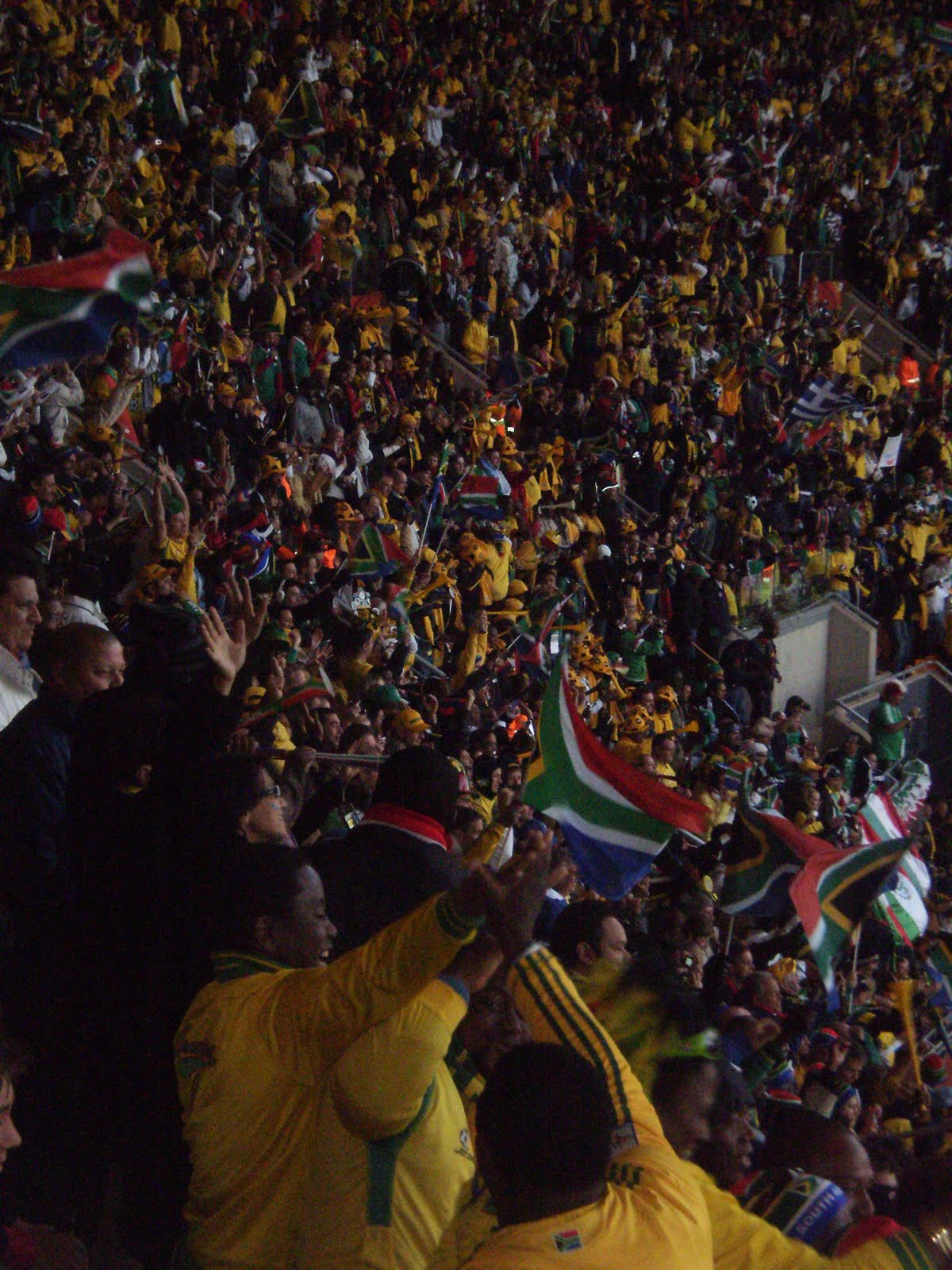
South Africa 1 Mexico 1
Well, that was a bit of a buzz. Which almost had a sting in the tail.
Even Sepp Blatter, football’s most powerful man, looked and sounded a little taken aback by the pure power and intensity of Africa’s long-awaited World Cup welcome, as he forgivably gifted himself a little pre-match speech on the pitch.
And just when the relentless intensity inside the Soccer City ‘cooking pot’ bowl had reached the very top of its range, somehow the crowd - that feverish swarm of vuvuzelas - could send the volume surging still higher to a Spinal Tap-style level eleven.
Siphiwe Tshabalala’s sweetly-lashed opener should guarantee the self-proclaimed YouTube addict a hefty segment of the site to himself.
He spoke before the match about spending hours following ‘best free-kick’ links, to hone his own set-piece technique, but today’s open-play piledriver could provide a few lessons of its own.
And not just in the finish – Fulham’s Kagisho Dikgacoi need feel no urge to change his name, after a clever and committed second-half display and the cute through-ball putting Tshabalala on a clear path into the history books.
Patches of empty seats suggested the announcement of a capacity 84,900 crowd might have been a little less accurate than Tshabalala’s aim.

Yet there could have been twice as many crammed inside here, judging by the racket this bouncing, beaming crowd created – expressing somehow both a nervous make-the-most-of-the-moment disbelief and a satisfied this-is-how-it-should-be self-assurance.
While there was little let-up in terms of sound from the fans, the home players’ own confidence came and went.
A rocky, sloppy start, as the Mexicans threatened to canter away with it, was followed by some modestly intricate passing moves as the first half scampered by – especially as Pienaar deserted his right-wing station as if worried he might miss out on some fun.
His team’s left flank certainly needed some bolstering, with Giovani dos Santos sparkling and yet often found himself usefully overlapped by his own right wing-back, Paul Aguilar.
Yet early indications that Aguilar and central midfield organiser Gerardo Torrado would run the match just the way they wanted gradually receded.
South Africa not only hung on until half-time – helped no little by goalkeeper Ike Khune and a dutifully-flagging linesman – but could have nodded themselves into the lead, had lumbering frontman Katlego Mphela.
Did Mexico really need to persevere with three men in central – if elastic – defence when faced by a harmless Mphela and, tucked just behind, a miscuing Teko Modise?
At least the belated arrival, in the second half, of Andres Guardado gave them both impetus and deadly crossing down the wing, even if by that point South Africa had taken the lead, missed a sitter (Modise) and been denied a perfectly-arguable penalty.
Rafael Marquez, curbing his instincts to roam like an old-fashioned centre-half for much of the game, did turn up in the right spot at the right time to swipe an equaliser.
South Africa had ten men in the box as Guardado’s crucial cross swept over, though captain Aaron Mokoena could feel aggrieved to find himself abandoned and left to cover up to four attacking Mexicans.
Inevitably, one of them ended up hitting the net, suggesting home coach Carlos Parreira – a zonal marking devotee – has at least a little more fine-tuning to do.
But the fans sounded a fairly forgiving bunch, the only moment of quickfire quiet coming in the few seconds after an anti-climactic – and inaudible – final whistle.
The pipes were soon parping again – surely lips should be chapped, lungs running out of puff? – as the makarapa-helmeted heads bobbed back down the stairs and ramps, out on to the streets, and into the night.

For the second World Cup in a row, an opening game has proved a refreshing and entertaining sight – though even that bubbly Allianz Arena crammed with even bubblier Bavarians never felt nor sounded quite like this.
"Tell me what you see..."
Just quickly, a few pre-tournament predictions:
Winners: Brazil – dull Dunga took great pride in their jogo bonito-lite triumph in 1994, and could repeat as coach what he achieved then as captain, with a robust and ruthlessly-efficient counter-attacking team. At least Kaka, Dani Alves and Maicon have class. The two old Gilbertos, both once of North London, look less understandable
Runners-up: Italy. Such a simple group means even they might struggle to make their archetypal slow start, so maybe they’ve just been getting it out of the way earlier in dispiriting pre-tournament friendlies. Not quite so ageing as expected (the sadly-going-going-long-gone Cannavaro aside), while the midfield has bite in De Rossi and craft in Montolivo. And they’ll be intent on resuming normal service against Spain.
Semi-finalists: Argentina, Ghana.
England’s prospects: Same old, same old quarter-final. Though, just to be original, having knocked out Germany in the second round.
Surprise packages: Well-organised but feisty Ghana, Marcelo Bielsa’s tactically-daring and flair-filled Chile.
Golden Boot winner: After the 2006 World Cup, for the first time, featured not a single hat-trick, how about Spain’s David Villa to hit two en route to the Golden Boot?
Non-superstar stars: Argentina’s Angel di Maria. Mexico’s Giovani dos Santos. Chile’s Matias Fernandez. New Zealand’s Chris James, also of Barnet. One of these, maybe not.
Miscellaneous: John Terry and/or Ashley Cole sent off. More English red cards, albeit a fair (or unfair) few flourished by Howard Webb. And unlike in 1966, North Korea to actually hold on for a draw against Portugal this time.
Winners: Brazil – dull Dunga took great pride in their jogo bonito-lite triumph in 1994, and could repeat as coach what he achieved then as captain, with a robust and ruthlessly-efficient counter-attacking team. At least Kaka, Dani Alves and Maicon have class. The two old Gilbertos, both once of North London, look less understandable
Runners-up: Italy. Such a simple group means even they might struggle to make their archetypal slow start, so maybe they’ve just been getting it out of the way earlier in dispiriting pre-tournament friendlies. Not quite so ageing as expected (the sadly-going-going-long-gone Cannavaro aside), while the midfield has bite in De Rossi and craft in Montolivo. And they’ll be intent on resuming normal service against Spain.
Semi-finalists: Argentina, Ghana.
England’s prospects: Same old, same old quarter-final. Though, just to be original, having knocked out Germany in the second round.
Surprise packages: Well-organised but feisty Ghana, Marcelo Bielsa’s tactically-daring and flair-filled Chile.
Golden Boot winner: After the 2006 World Cup, for the first time, featured not a single hat-trick, how about Spain’s David Villa to hit two en route to the Golden Boot?
Non-superstar stars: Argentina’s Angel di Maria. Mexico’s Giovani dos Santos. Chile’s Matias Fernandez. New Zealand’s Chris James, also of Barnet. One of these, maybe not.
Miscellaneous: John Terry and/or Ashley Cole sent off. More English red cards, albeit a fair (or unfair) few flourished by Howard Webb. And unlike in 1966, North Korea to actually hold on for a draw against Portugal this time.
Subscribe to:
Posts (Atom)